
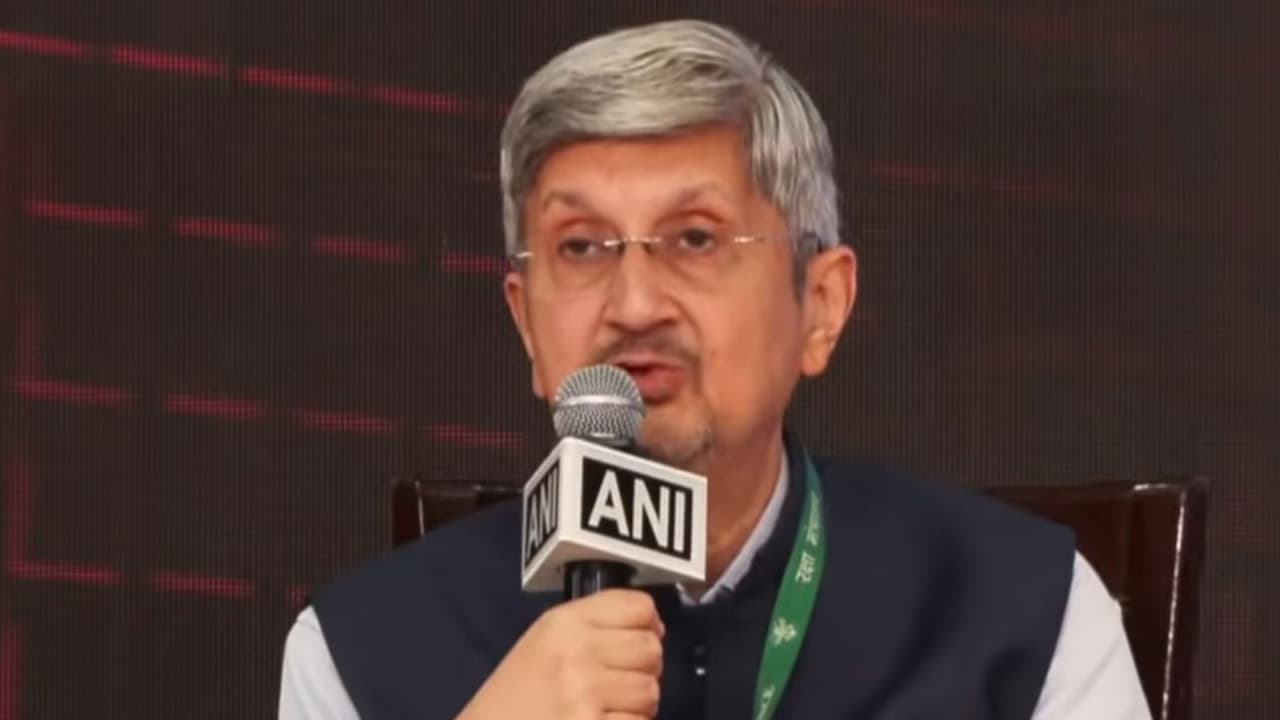
DRDO Chairman Samir V Kamat said India's LR-AShM hypersonic glide missile is in an advanced stage, with initial trials expected soon. The missile is designed for the Indian Navy's coastal battery requirements and can engage both static and moving targets.
LR-AShM: Features and Capabilities
The Long-Range Anti-Ship Missile (LR-AShM) is designed to meet the coastal battery requirements of the Indian Navy. It is a hypersonic glide missile capable of engaging both static and moving targets and can carry a range of payloads.The missile uses indigenous avionics and high-accuracy sensor packages.The HGV follows a quasi-ballistic trajectory, reaching speeds of up to Mach 10 and maintaining an average speed of around Mach 5 with multiple skips. It is equipped with indigenous sensors to engage moving targets in the terminal phase.Due to its low-altitude flight, high speed and manoeuvrability, the missile is difficult to detect for most of its trajectory by enemy ground and ship-based radars.The LR-AShM uses a two-stage solid propulsion rocket motor. The first stage separates after burnout, while the second stage boosts the missile to hypersonic speeds. It then enters an unpowered glide phase, carrying out manoeuvres before striking the target.DRDO's Two-Pronged Hypersonic Strategy
Speaking at the ANI National Security Summit, Kamat said India is working on both hypersonic glide and hypersonic cruise missile systems, with the glide variant currently ahead. "With respect to the hypersonic, we are working on two programs, the Hypersonic Glide Missile and the Hypersonic Cruise Missile," he said.Glide Missile vs. Cruise Missile
He explained the difference between the two systems. "The hypersonic cruise missile... has a scramjet engine and it is powered during its flight. The hypersonic glide missile...uses a booster to give it initial velocity and then it just glides without any powering," he said.Kamat indicated that the glide missile could be tested soon. "The glide missile will come out first... we should be doing the first trials fairly soon and that is at a more advanced stage than the cruise missile," he added.Vision for a Conventional Missile Force
He also outlined the structure of a proposed conventional missile force, which is still under consideration. According to him, the force would require a mix of systems for different ranges and tactical roles. "So with respect to the conventional missile force, as the defence secretary mentioned, the structure has not yet been formed, but what I consider would be required in a conventional missile force would be ballistic missiles for short ranges, medium ranges, and ranges maybe up to 2000 kilometers," he said.He stressed the need for a diverse arsenal. "So you would need ballistic missiles of these three types and you would also need cruise missiles, you would need hypersonic missiles... it would consist of a variety of missiles which give you the capability of striking at different ranges for tactical application," he added.Current Systems and Preparedness
On current preparedness, Kamat said short-range systems are nearing induction. "For short-range ballistic missiles, the Pralay which is now in the final stages of testing, that should be ready," he said.He added that some existing systems could be adapted. "Then we have some of our strategic missiles which can be converted to tactical usage for the medium range and the higher ranges," he said.India's Hypersonic Milestones
In general hypersonic missile is capable of travelling at speeds exceeding five times the speed of sound, or over 6,100 km per hour. Hypersonic cruise missiles use air-breathing scramjet engines, which enable sustained high-speed flight through supersonic combustion.India has achieved several milestones in this field in recent years. In November 2024, Defence Research and Development Organisation conducted a successful flight trial of a long-range hypersonic missile from Dr APJ Abdul Kalam Island off the Odisha coast. The missile demonstrated accurate terminal manoeuvres and a range beyond 1,500 kilometres.Earlier, in 2020, DRDO successfully tested the Hypersonic Technology Demonstration Vehicle, validating scramjet propulsion and sustained hypersonic flight.In January this year, the Defence Research and Development Laboratory carried out a long-duration ground test of an actively cooled scramjet combustor for over 12 minutes, validating key technologies required for hypersonic cruise missiles.Defence Minister Rajnath Singh had then described the earlier hypersonic missile test as a "historic achievement" that places India among a select group of nations with such advanced capabilities. (ANI)(Except for the headline, this story has not been edited by Asianet Newsable English staff and is published from a syndicated feed.)Add Asianet Newsable as a Preferred Source
