
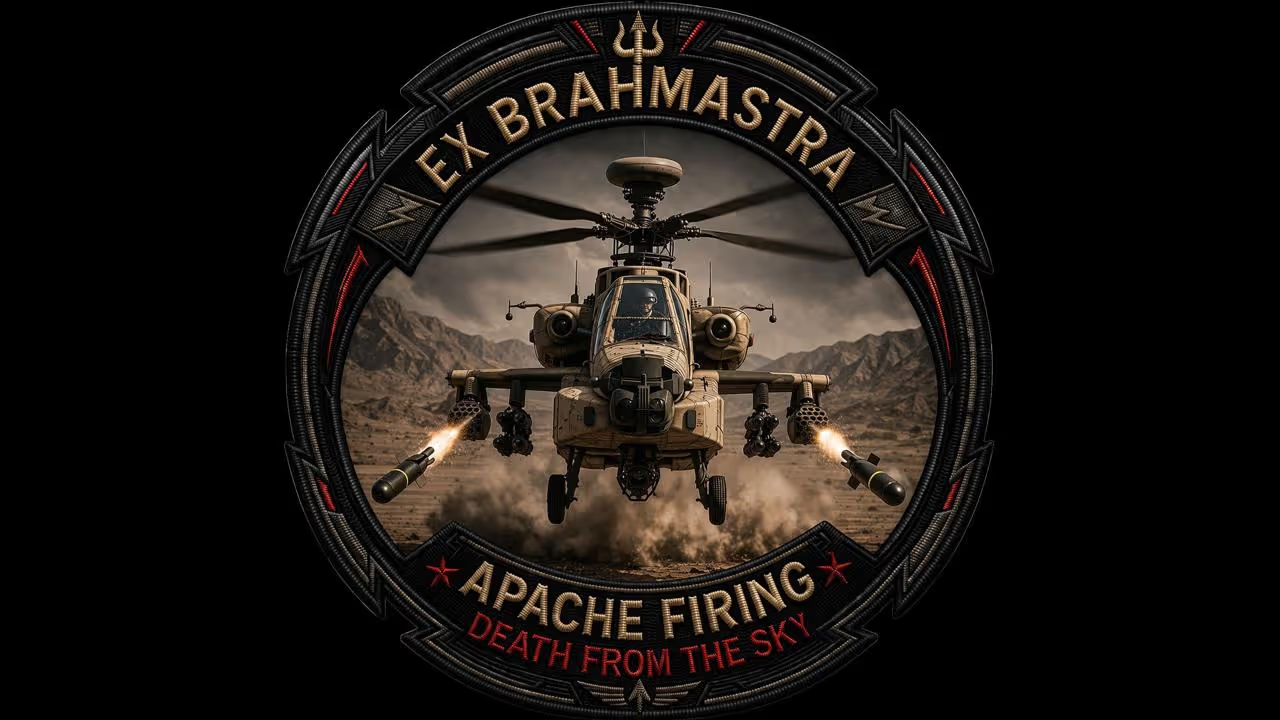
The Indian Army's AH-64 Apache helicopter fired AGM-114 Hellfire missiles for the first time in India during the 'Brahmastra' exercise in Pokhran. This marked a significant operational milestone, demonstrating the American-built gunship's precision strike capability and combat readiness in support of ground troops.
An AH-64 Apache attack helicopter fired AGM-114 Hellfire missiles at ground targets during live field firing exercise ‘Brahmastra’ at Rajasthan's Pokhran ranges on Thursday. It was for the first time the American-built gunship has conducted such an exercise in India since its induction into the Indian Army five years ago.

The Apache successfully engaged targets with Hellfire missiles and other onboard weapon systems at the Pokhran Field Firing Ranges, in what the Army described as a demonstration of rapid target acquisition and precision strike capability in support of ground troops.
The exercise marked a significant operational milestone for the Army Aviation Corps, establishing the Apache's live combat readiness in the Indian theatre.
The two-day exercise was designed to demonstrate how attack helicopters can operate in direct support of ground troops in contested environments — including conditions involving small arms fire, man-portable air defence systems, and drone threats.
The Apache entered service with the Indian Army in 2020 under a government-to-government deal with the United States, and is deployed primarily in anti-armour and close support roles along the northern and western sectors.
An Indian Army official said advanced sensors, fire control systems, and real-time data links enabled faster decision cycles during the exercises, allowing battlefield intelligence to be converted into immediate strikes.
The Army characterised the Apache as extending the reach and lethality of ground forces, while the Prachand was presented as evidence of India's growing self-reliance in combat aviation.
The demonstrations reflect a broader doctrinal shift within the Indian Army towards tighter integration of air and land assets — an approach that has gained renewed urgency following conflicts in Ukraine and Gaza, where coordination between rotary-wing aviation and ground forces has proved tactically decisive.
A day earlier, on Wednesday, Indian Army chief General Upendra Dwivedi flew aboard the Light Combat Helicopter Prachand at Hindustan Aeronautics Limited's facility in Bengaluru — a sortie that carried its own institutional weight, signalling the Army leadership's backing for the indigenous platform at a time when HAL is seeking further orders from both the Army and the Navy.
The Prachand, developed by HAL and inducted in 2022, is optimised for high-altitude operations — a capability of particular relevance given the continuing military standoff in eastern Ladakh.
