Amid rising tensions after Iran launched missile strikes on countries hosting United States forces, India urges restraint, diplomacy, and warns nationals in the Gulf region to stay vigilant.
India on Saturday expressed deep concern over the rapidly escalating tensions in the Middle East after Iran launched missile attacks on several countries that host American military forces. In an official statement, India’s Ministry of External Affairs (MEA) called for restraint and emphasised the need for diplomacy as the situation threatens to destabilise the Gulf region.

“India is deeply concerned at the recent developments in Iran and the Gulf region,” the statement read.
Related Articles

“We urge all sides to exercise restraint, avoid escalation, and prioritise the safety of civilians. Dialogue and diplomacy should be pursued to de-escalate tensions and address underlying issues. Sovereignty and territorial integrity of all states must be respected,” it added.
“Our Missions in the region are in touch with Indian nationals and have issued appropriate advisories asking them to remain vigilant, stay in contact with the Missions, and follow local security guidance,” the MEA further added.
Also read: Dubai Airports in Chaos: Flights Cancelled, Passengers Stranded Amid Iran Strikes (WATCH)
US And Israel Launch Strikes Across Iran
The escalation began after the United States and Israel carried out a wave of strikes across Iran on Saturday, triggering explosions in the capital Tehran and raising fears of a wider regional conflict.
Smoke was seen rising over Tehran as the strikes began. Shortly after, US President Donald Trump announced US combat operations in Iran through a video statement on his Truth Social platform, saying the goal was to eliminate “imminent threats”.
The Israeli military said it had targeted multiple sites in Tehran where senior Iranian officials were gathered and added that it was assessing the results of the attack. It also said missile launchers in western Iran were among the targets after months of joint planning between the allies.
Israel’s public broadcaster Kan reported that the strikes targeted Iran’s Supreme Leader Ali Khamenei and President Masoud Pezeshkian.
In one of the deadliest incidents reported, at least 51 students were killed in a strike on a girls’ school in southern Iran, according to state media, after a provincial official said the deaths were linked to Israeli strikes.
Separately, in southern Iraq, a bombing targeting a military base housing a pro-Iran group killed at least two people, authorities said.
Iran Launches Missile And Drone Retaliation
In response, Iran’s Revolutionary Guards said they had begun retaliatory strikes.
“The first wave of widespread missile and drone attacks by the Islamic Republic of Iran against the occupied territories has begun,” the Islamic Revolutionary Guard Corps (IRGC) said in a statement, referring to Israel.
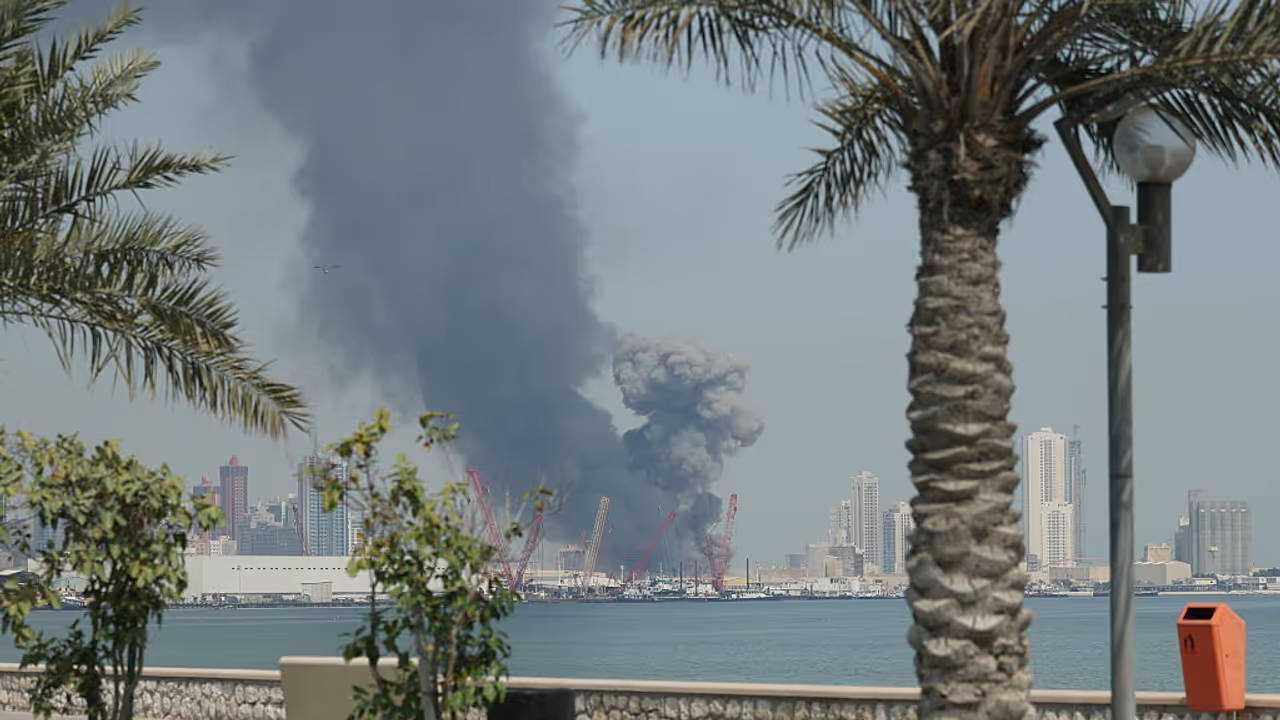
Iran also said it targeted the US Fifth Fleet in Bahrain as part of its response.
Israel’s emergency service said it was treating a man with blast injuries in the north of the country after missiles were launched from Iran, while the Israeli military deployed search and rescue teams to several locations following reports of fallen projectiles.
Iran’s foreign ministry said it would “respond decisively” to the strikes and insisted Tehran had done “everything necessary to prevent war” from breaking out.
“Just as we were ready for negotiations, we are now more prepared than ever to defend the Iranian nation,” it said.
Gulf Region On Edge After Explosions And Interceptions
The conflict quickly spilled beyond Iran and Israel, with explosions and interceptions reported across multiple countries in the Gulf.
In United Arab Emirates, authorities said they intercepted a second wave of Iranian missile strikes after debris from an earlier attack killed a civilian in Abu Dhabi. Witnesses in Dubai reported seeing missiles streak across the sky.
Explosions were also heard in the Saudi capital Riyadh, as well as in the capitals of Bahrain and Qatar.
Qatar’s defence ministry said it intercepted several missile attacks targeting the Gulf state, while Kuwait said it had engaged incoming strikes.
Saudi Arabia condemned Iranian attacks targeting neighbouring countries but did not report being targeted itself.
Meanwhile, Jordan said it shot down two ballistic missiles and vowed to defend its interests “with all its might”.
Explosions were also reported near the US consulate in Erbil in Iraq, according to AFP journalists.
Key US Military Sites Under Threat
Several countries hosting US military infrastructure reported attacks or attempted strikes as Iran widened its retaliation.
In Bahrain, authorities said an Iranian missile strike targeted the service center of the US Navy’s Fifth Fleet, located at Naval Support Activity Bahrain — a major American naval hub in the Gulf.
Kuwait’s defence ministry said its forces intercepted missiles targeting Ali al-Salem Air Base, a key logistics and airlift hub for US operations in the region. However, Italy’s foreign minister said an Iranian strike caused “significant damage” to the runway.
In Qatar, Iranian missiles targeted the country’s territory, which hosts Al Udeid Air Base — one of the most important US military installations in the Middle East.
Casualties Reported In Syria
In Syria, state media reported that four people were killed after an Iranian missile struck the country’s south.
The United States has maintained a military presence in Syria for years as part of operations against the Islamic State group, although American forces are currently in the process of withdrawing.
Global Reactions Pour In
World leaders reacted quickly as fears grew that the conflict could spiral into a wider war.
French President Emmanuel Macron called for an urgent United Nations Security Council meeting over the escalation.
Australia’s Prime Minister Anthony Albanese said Canberra supports the US action, while the United Kingdom warned that the strikes could escalate into a broader regional conflict.
The European Union described the developments as “perilous” and urged the protection of civilians.
Russia condemned the strikes as a dangerous move that could lead to catastrophe in the region, while Pakistan called the attacks on Iran “unwarranted” and urged an immediate halt to escalation.
The Palestinian group Hamas also condemned the strikes on Iran, one of its key backers.
Airspace Closures And Flight Disruptions
As the conflict intensified, several countries shut or restricted their airspace.
Qatar temporarily closed its airspace and Qatar Airways suspended all flights from Doha. Iraq shut its airspace entirely, while Syria closed parts of its southern airspace near the Israeli border.
Multiple airlines, including Air France, Lufthansa, Turkish Airlines and Air India, cancelled or suspended flights to several Middle Eastern destinations amid safety concerns.