
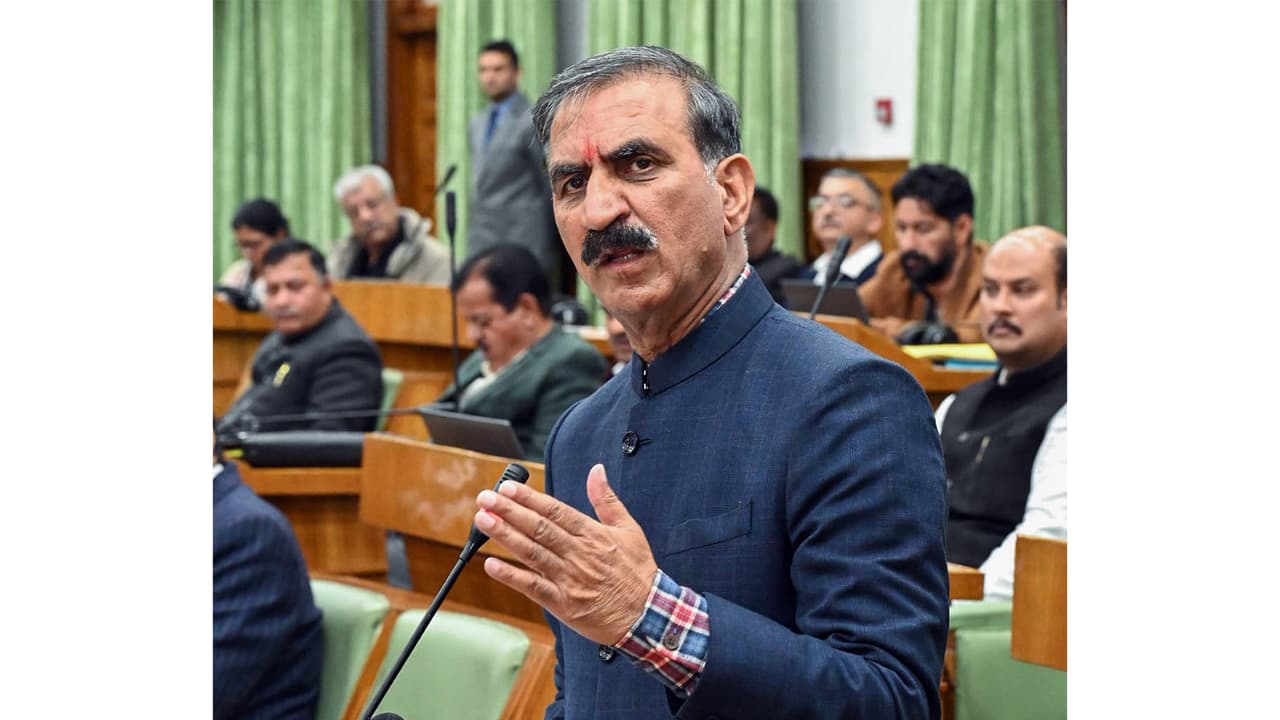
The Himachal Pradesh government unveiled a Rs 54,928 crore budget for 2026-27, targeting rural growth and social welfare while implementing austerity measures like salary cuts for the CM and ministers to manage fiscal pressures.
The Himachal Pradesh government on Saturday presented a Rs 54,928 crore budget for 2026-27, focusing on strengthening the rural economy and fulfilling key election guarantees, while simultaneously announcing austerity measures, including temporary salary cuts for top functionaries.

Key Focus on Self-Reliance and Welfare
Presenting his fourth budget, Chief Minister Sukhvinder Singh Sukhu said the government aims to make Himachal Pradesh a self-reliant state by 2030, with a strong emphasis on rural development, agriculture, and social welfare.
As part of its flagship commitments, the government announced financial assistance of Rs 1,500 per month to women from one lakh families, provision of 300 units of free electricity per month, and the setting up of a dedicated commission for farming to boost the agriculture sector.
Austerity Measures Amid Fiscal Constraints
Amid financial constraints, the Chief Minister also unveiled temporary salary cuts, including a 50 per cent reduction in his own salary, 30 per cent for ministers and senior bureaucrats, and 20 per cent for MLAs and other officials. The move is aimed at easing fiscal pressure without impacting welfare schemes.
The budget size reflects a reduction of Rs 3,586 crore compared to the previous fiscal year's Rs 58,514 crore. The state's debt has crossed Rs 1 lakh crore, underscoring the challenging fiscal environment.
Budgetary Figures and Projections
According to estimates, revenue receipts stand at Rs 40,361 crore, while revenue expenditure is pegged at Rs 46,938 crore, leading to a revenue deficit of Rs 6,577 crore. The fiscal deficit is projected at Rs 9,698 crore.
Despite these constraints, the state economy is expected to grow at 8.3 per cent, with the Gross State Domestic Product (GSDP) estimated at Rs 2,54,000 crore and per capita income at Rs 2,83,626.
The expenditure pattern indicates that for every Rs 100 spent, Rs 27 will go towards salaries, ₹21 for pensions, Rs 13 for interest payments, Rs 9 for debt repayment, and Rs 20 for capital works and development, while Rs 10 is allocated as grants to autonomous institutions.
Sector-wise Allocations
Sector-wise, education has been allocated Rs 9,660 crore, health Rs 2,868 crore, women and child development and welfare of Other Backwards Classes Rs 1,544 crore, urban development Rs 542 crore, and energy Rs 250 crore.
Budget Presentation Highlights
The budget speech was delivered in three parts over 4 hours, 9 minutes, and 31 seconds. In a symbolic shift towards sustainability, Sukhu arrived at the Assembly in an electric vehicle this year, unlike previous years when he drove his personal car to present the budget.
The budget reflects the government's dual approach of fiscal discipline and welfare expansion, with a clear focus on rural empowerment and long-term economic self-reliance.
(Except for the headline, this story has not been edited by Asianet Newsable English staff and is published from a syndicated feed.)
