
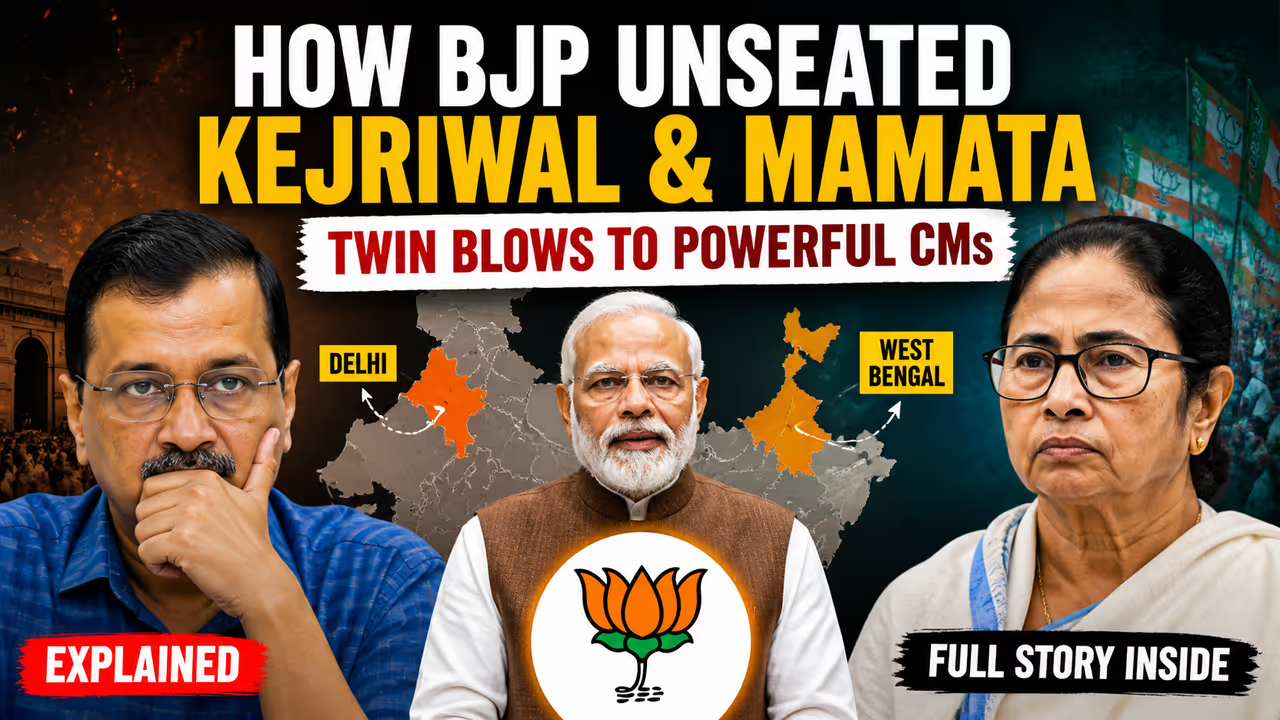
In the 2026 elections, the Bharatiya Janata Party (BJP) secured historic victories in Delhi and West Bengal, unseating chief ministers Arvind Kejriwal and Mamata Banerjee. The BJP formed a government for the first time in West Bengal, ending Banerjee’s 15-year rule.
The 2026 election cycle has delivered two of the most significant political upsets in recent Indian history, as the Bharatiya Janata Party (BJP) successfully unseated two powerful and once seemingly invincible chief ministers—Arvind Kejriwal in Delhi and Mamata Banerjee in West Bengal. These twin victories mark a major consolidation of BJP’s political dominance and signal a shift in voter sentiment across key regions.

Twin Political Upsets: How BJP Toppled Kejriwal and Mamata
In West Bengal, the BJP achieved a historic breakthrough by forming the government for the first time, ending Mamata Banerjee’s 15-year rule. The party secured a sweeping mandate, crossing the 200-seat mark in the 294-member Assembly, a scale of victory that reshaped the state’s political landscape.
The defeat was particularly symbolic as Mamata Banerjee lost her own constituency, Bhabanipur, to BJP leader Suvendu Adhikari, underlining the depth of the anti-incumbency wave and the effectiveness of BJP’s campaign. The result echoed a dramatic reversal of fortunes in a state long considered resistant to the BJP’s expansion.
BJP’s campaign in Bengal focused heavily on governance issues, allegations of corruption, and concerns around law and order. It also leveraged a strong organisational network and high-decibel campaigning led by Prime Minister Narendra Modi and Home Minister Amit Shah. Analysts point out that a shift in urban voter preferences and broader dissatisfaction with the incumbent government played a crucial role in the outcome.
Meanwhile, Mamata Banerjee strongly contested the results, calling the outcome “immoral” and “illegal,” and alleging that over 100 seats were “looted.” Her remarks reflect the intense political tensions surrounding the verdict and the high stakes involved in the election.
In parallel, the BJP also dealt a major blow to Arvind Kejriwal in Delhi, marking another high-profile political defeat. Once seen as a formidable challenger with a governance-focused model, Kejriwal’s loss highlights the BJP’s ability to penetrate urban strongholds and counter regional leadership narratives.
Also Read: The Great Squeeze: How BJP & Congress Are Shrinking Space For Regional Parties
Strategy, Anti-Incumbency and the Rise of National Leadership
A key factor behind these twin victories has been the BJP’s centralised campaign strategy and the enduring popularity of Prime Minister Narendra Modi. Elections are increasingly being framed around national leadership and performance, reducing the advantage traditionally enjoyed by strong regional leaders.
Additionally, anti-incumbency sentiment played a decisive role in both cases. In West Bengal, nearly a decade and a half of TMC rule led to voter fatigue, while in Delhi, governance concerns and political controversies weakened the incumbent’s appeal. The BJP effectively capitalised on these sentiments by presenting itself as a stable and decisive alternative.
Another crucial element has been the party’s organisational strength and ability to mobilise voters at the grassroots level. From booth-level management to targeted messaging, the BJP’s election machinery has proven highly effective in converting political momentum into electoral success.
The broader implication of these victories is a significant shift in India’s political balance. By defeating two prominent opposition leaders in their respective strongholds, the BJP has reinforced its position as the dominant national force.
These developments also raise important questions about the future of regional leadership in India. As national narratives gain prominence and voter preferences evolve, regional parties may find it increasingly challenging to sustain their influence.
In essence, the fall of Kejriwal and Mamata Banerjee represents more than individual defeats—it reflects a larger transformation in Indian politics, where centralised leadership, organisational strength, and voter demand for change are redefining the electoral landscape.
Also Read: BJP’s Big Leap Explained: How NDA Expanded to 21 States, Rewriting India’s Political Map
