
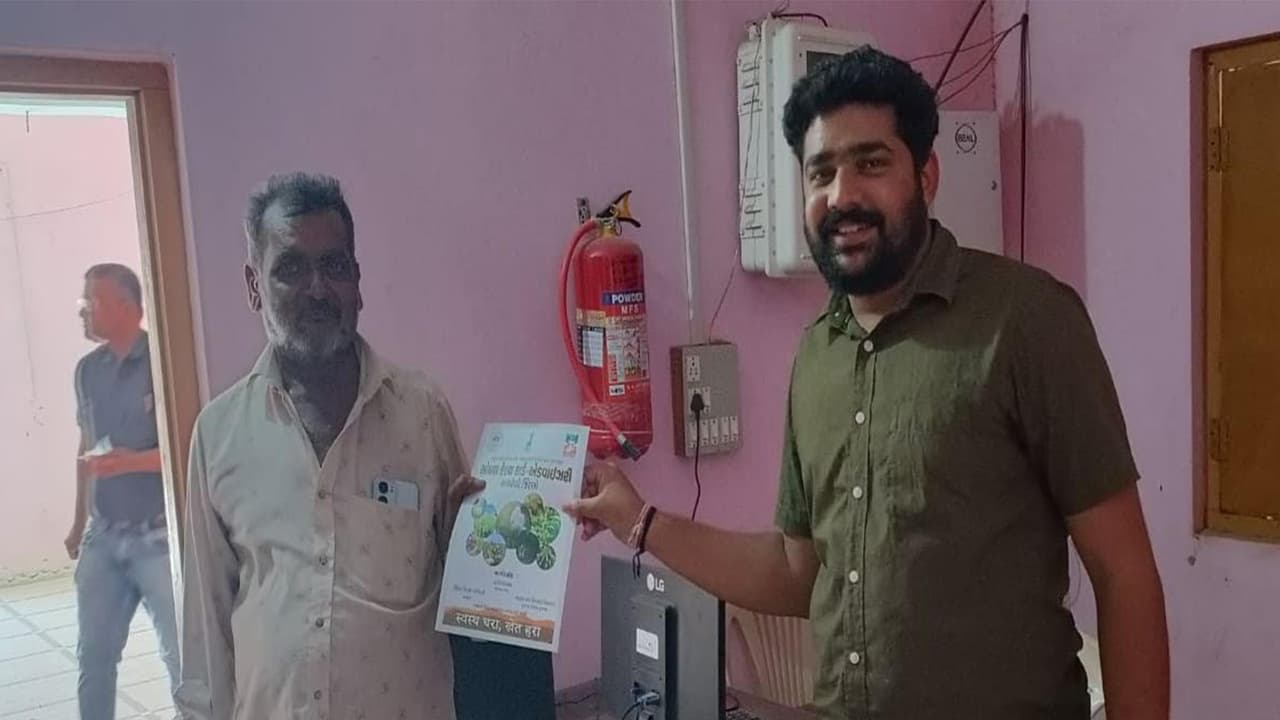
Gujarat has strengthened sustainable agriculture by issuing over 2.19 crore Soil Health Cards to farmers. The scheme, pioneered in 2003-04, provides scientific guidance on soil health, reducing costs and improving crop yields for farmers.
Gujarat has issued more than 2.19 crore Soil Health Cards (SHCs) to farmers so far, strengthening its focus on sustainable agriculture and scientific farming practices, according to the Chief Minister's Office.

Agriculture has always remained central to Gujarat's holistic development. When cultivable land is not managed with care, it risks turning unproductive due to pollution, increasing soil salinity, and excessive use of chemical fertilisers and pesticides, as per the release. This concern was visible in several parts of the state. To address this challenge, the then Chief Minister of Gujarat and current Prime Minister Shri Narendra Modi introduced the Soil Health Card Scheme in 2003-04 with the guiding mantra 'Swasth Dhara, Khet Hara'. With this pioneering step, Gujarat became the first state in India to launch such an initiative, recognising that healthy soil is the foundation of sustainable farming. Carrying this vision forward, Gujarat continues to strengthen its agricultural progress under the leadership of Chief Minister Shri Bhupendra Patel. So far, 2.19 crore farmers in the state have been issued Soil Health Cards.
Scheme Implementation and National Rollout
The Soil Health Card scheme helps maintain the fertility of farmable land by analysing soil health in a systematic way. Soil samples are collected from farmers' fields following a prescribed method and sent to testing laboratories for analysis. Based on the results, a software-generated Soil Health Card is prepared, showing the levels of 12 key elements in the soil: N, P, K, pH, EC, Fe, Cu, Zn, OC, S, B, and Mn. Using this information, farmers receive scientific guidance on the type and quantity of fertilisers to use, completely free of cost, a release added. This approach reduces the unnecessary use of chemical fertilisers and ensures that the soil remains productive over time.
Following the scheme launch, the first phase was implemented from 2003-04 to 2010-11, followed by the second phase from 2011-12 to 2015-16. During the first phase, more than 43.03 lakh farmers in Gujarat received Soil Health Cards free of cost. In the second phase, approximately 46.92 lakh farmers were provided the cards at no charge. After its success in Gujarat, the Prime Minister rolled out the Soil Health Card Scheme across the country in 2015-16. Under this national initiative, and during the third phase from 2016-17 till now, more than 1.25 crore farmers in Gujarat have been issued Soil Health Cards under the Government of India's scheme.
Farmer Success and Cost Efficiency
Over the years, the scheme has significantly enhanced farmers' understanding of soil deficiencies and promoted the use of micronutrient fertilisers. Babubhai Vasarambhai Patel, a farmer from Dhansura in the Aravalli district, said the SHC scheme's recommendations on limited use of essential fertilisers led to lower costs and improved crop yields, demonstrating the initiative's impact on both productivity and cost efficiency, a release said.
Current Targets and Ongoing Analysis
In 2024-25, a total of 6,23,844 soil samples were collected online through the SHC portal, of which 6,23,295 samples were analysed. For 2025-26, the Government of India has set a target of testing 6,25,513 soil samples in Gujarat. The Government of Gujarat remains committed to achieving this target within the stipulated time.
So far, 6,13,355 samples have been collected by the State Government, and analysis of 4,86,142 samples has been completed. Testing of the remaining samples is currently in progress.
Strengthening Laboratory Infrastructure
To ensure timely analysis and distribution of Soil Health Cards, laboratory capacity is being strengthened. Currently, 19 soil testing laboratories and one microelement testing laboratory are operational under the Agriculture Department in Gujarat, each with an annual capacity of 10,000 to 11,000 samples. In addition, 26 private village-level laboratories, supported by government aid, can analyse about 3,000 samples each per year.
Holistic Benefits of the Scheme
The Soil Health Card scheme helps farmers with clear insights into soil health, improves fertility, guides suitable crop selection, reduces input costs, enhances returns, and promotes scientific farming practices. (ANI)
(Except for the headline, this story has not been edited by Asianet Newsable English staff and is published from a syndicated feed.)