
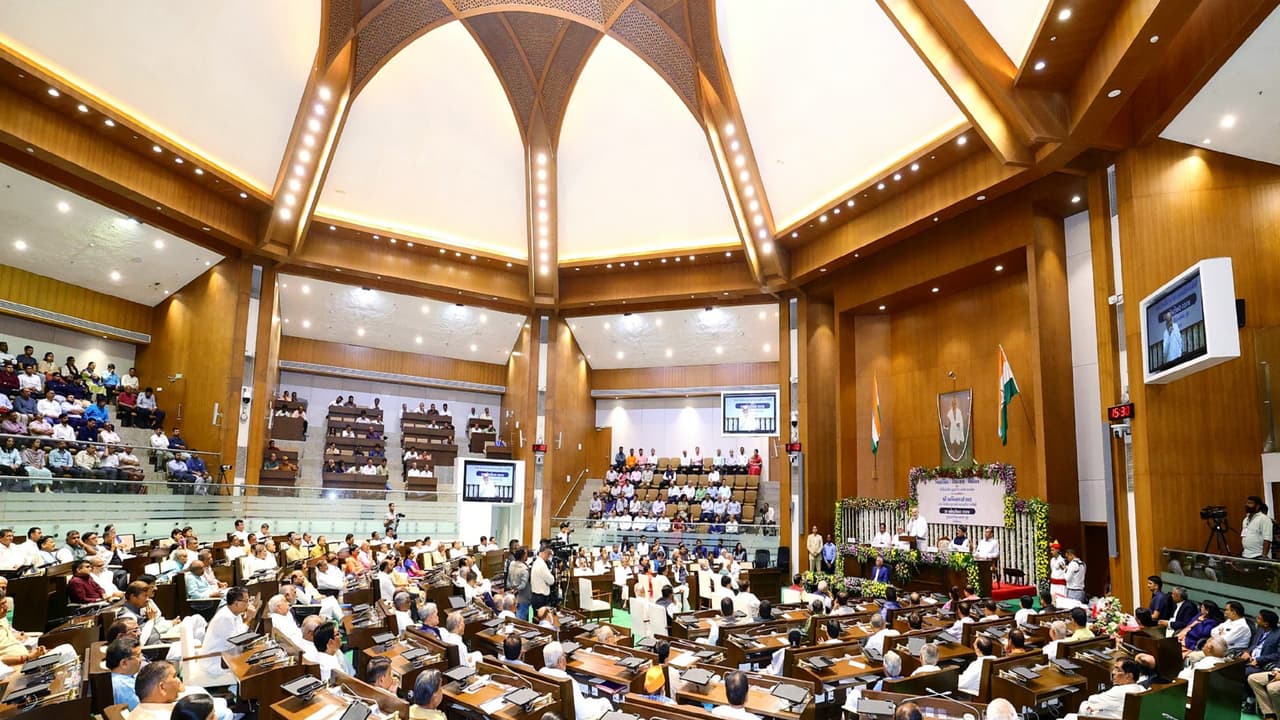
Gujarat's Assembly has passed the Uniform Civil Code (UCC) Bill, making it the second state to do so. The bill mandates registration for marriages and live-in relationships and establishes uniform rules for divorce and inheritance across communities.
The Gujarat Assembly has passed the Uniform Civil Code (UCC) Bill with a majority, making the state the second in the country to implement the bill after Uttarakhand. Chief Minister Bhupendra Patel emphasised that it embodies the principle of equality and justice as its core, applying to all irrespective of their caste and religion.

Key Provisions of the UCC Bill
The Bill aims to mandate registration of marriages, registration of live-in relationships, uniform rules for divorce, equal inheritance rights for daughters and sons, and strict implementation with penalties. Highlighting that the UCC bill has been introduced in light of the Supreme Court judgments, CM Patel added that a comprehensive perspective has been adopted by studying similar laws in democratic countries around the world.
Marriage Registration and Penalties
In this bill, one of the key provisions is that couples would have to register their marriage within 60 days, and the failure to comply would attract a penalty of up to Rs 10,000. Cases of forced, coerced, or fraudulent marriages may attract punishment of up to 7 years, and similar punishment applies for multiple marriages. "Mandatory registration ensures legal recognition, protects women and children, and prevents fraudulent marriages," said Patel.
Uniform Divorce Process
In cases of divorce, it would have to be registered after a court approval and would be invalid without one. Such invalid divorces may attract punishment up to 3 years, and women are granted the right to remarry without conditions. "This ensures transparency, prevents fraud, and establishes a uniform and fair divorce process across communities," said the CM.
Mandatory Registration of Live-in Relationships
Registration of live-in relationships is also mandatory under this Bill, and failure may result in imprisonment for up to 3 months or a fine of Rs 10,000. If the involved individuals are between 18 and 21 years, their parents will be informed, with strict punishment in place for coercion or fraud. POCSO provisions apply in cases involving minors, and strict penalties apply if a married person enters into a live-in relationship.
Protecting Women and Children
The Chief Minister championed the Bill's benefits for women and children, noting that it guarantees financial maintenance for women and ensures legal recognition for all children. "Registration helps regulate such relationships and protects women from abandonment. It also ensures better protection of children's rights to identity, maintenance, and inheritance," he said.
A 'Historic Moment' for Gujarat
After the bill was passed in the Assembly, CM Patel took to X to congratulate the representatives and citizens of the state, hailing it as a "historic moment for Gujarat and the country".
"Due to the implementation of the Uniform Civil Code, a common legal framework will be implemented in the state for all religions and communities on issues like marriage, divorce, inheritance and adoption. It will be ensured that women of all religions and castes get equal rights, so that their status of respect and security will be further strengthened," the CM wrote on X.
He noted that "geographical and cultural diversity" of the state has been considered so that "no community is treated unfairly". "A high-level committee formed under the chairmanship of retired Supreme Court judge Justice Ranjana Prakash Desai submitted its final report on the UCC to the state government. In which all the necessary issues have been studied in detail, and this bill has been drafted by visiting the districts of the state, obtaining public opinions and close public relations," the post continued.
ગુજરાત વિધાનસભામાં સમાન નાગરિક સંહિતા (UCC) વિધેયક બહુમતીથી પસાર થવા બદલ રાજ્યના સૌ જનપ્રતિનિધિઓ અને સૌ નાગરિકોને અભિનંદન પાઠવું છું. ગુજરાત અને દેશ માટે આ એક ઐતિહાસિક ક્ષણ છે. આ સાથે જ ગુજરાત UCC લાગુ કરનારૂ દેશનું બીજું રાજ્ય બન્યું છે. સમાન નાગરિક સંહિતાના અમલના લીધે… — Bhupendra Patel (@Bhupendrapbjp) March 24, 2026
Expressing confidence that the implementation of UCC will strengthen the "social fabric of the state", the CM said that it would create an environment for development for people of all societies and communities. "We will be able to move forward more quickly to realize the vision of a developed India given by the Honorable Prime Minister Shri Narendrabhai Modi by building a developed Gujarat," the post concluded.
'Equal Gujarat, Empowered Gujarat'
Echoing these sentiments, Deputy CM Harsh Sanghavi emphasised that the passage of the UCC bill reinforces the principle that all citizens are equal in the eyes of the law. "Historic! Under the leadership of Hon'ble Chief Minister Shri Bhupendra Patel ji, the BJP government has passed the UCC in the Legislative Assembly. No one above the law. No citizen below. Equal Gujarat. Empowered Gujarat," he wrote on X.
Constitutional Context: Article 44
Article 44 of the Indian Constitution, under the Directive Principles of State Policy, directs the state to strive for a Uniform Civil Code (UCC) for all citizens across India. It aims to replace diverse personal laws governing marriage, divorce, and inheritance with a common, secular legal framework to promote equality, national integration, and gender justice. (ANI)
(Except for the headline, this story has not been edited by Asianet Newsable English staff and is published from a syndicated feed.)