
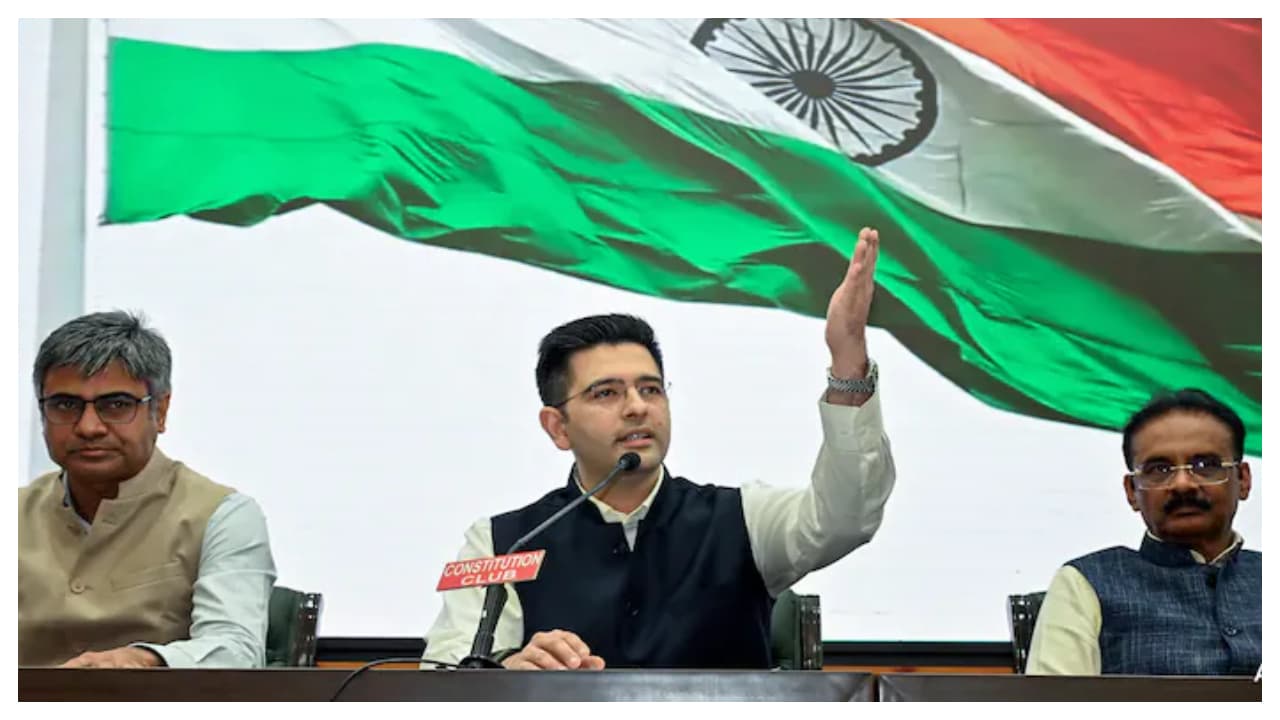
Raghav Chadha and six other Rajya Sabha MPs have left the Aam Aadmi Party (AAP), significantly altering Punjab's political landscape before state elections. This rebellion provides the Bharatiya Janata Party (BJP), historically a minor player in Punjab, with recognizable faces and a stronger parliamentary presence.
Raghav Chadha’s decision to leave the Arvind Kejriwal-led Aam Aadmi Party (AAP) along with six Rajya Sabha MPs has done more than trigger a crisis inside the party — it may have also reshaped the political battlefield in Punjab ahead of the state’s crucial assembly elections next year.

The dramatic rebellion has immediately changed the political arithmetic in a state where AAP currently governs and where the Bharatiya Janata Party has historically struggled to establish itself as a dominant force. Six of the seven MPs who left AAP are linked to Punjab, making the rebellion particularly significant for a state that votes in less than a year.
Why Chadha’s Exit Matters For Punjab Politics
For years, the BJP remained a marginal player in Punjab politics. In the 2022 state assembly election, the party managed to win only two seats in the 117-member assembly. Despite its national dominance, the BJP has long battled the perception in Punjab that it remains an outsider in a state where regional identity and Sikh-majority politics often shape electoral outcomes.
The entry of Chadha and other former AAP lawmakers now gives the BJP something it has lacked in Punjab — a stronger parliamentary presence and recognisable political faces with influence in the state. Political observers say the shift could help the BJP build momentum before the next election, even if turning that momentum into votes remains a difficult challenge.
Chadha framed the move as a matter of principle rather than political convenience.
He said, “AAP, that I nurtured with my blood and sweat and to which I gave 15 years of my youth, has completely strayed from its principles, values and core morals.”
He also declared, “I am the right man in the wrong party.”
Those remarks signalled that the split had been building for months and was not simply a sudden fallout. Reports suggest tensions inside AAP had intensified after Chadha was sidelined within the party and disagreements emerged over Punjab’s governance and the party’s future direction.
Also Read: Anna Hazare slams Raghav Chadha for joining BJP, calls it ‘not right’
How The Defection Changes BJP’s Strategy
The rebellion also carried major legal significance. Under India’s anti-defection law, lawmakers can avoid disqualification if at least two-thirds of a parliamentary party merge with another party. Because seven of AAP’s 10 Rajya Sabha MPs moved together, the group crossed that threshold and protected their seats.
For the BJP, the timing could not be better.
Punjab is one of the few major states where the party still seeks deeper political roots. Union Home Minister Amit Shah has already made clear that the BJP wants to contest Punjab independently rather than revive old alliances. The arrival of leaders who understand AAP’s organisation from inside could strengthen the party’s campaign strategy in a state where it has struggled to connect beyond urban pockets.
However, analysts caution that parliamentary numbers alone do not guarantee an electoral breakthrough.
Punjab remains politically distinct from many other states where the BJP has expanded. Rural influence, Sikh religious identity, and lingering resentment over the now-repealed farm laws continue to shape voter attitudes. The BJP’s national appeal does not automatically translate into local acceptance in Punjab.
AAP Faces Its Biggest Internal Test
AAP, meanwhile, has tried to turn the defections into a political attack on the BJP.
Arvind Kejriwal accused the BJP of engineering the rebellion to weaken opposition parties before state polls. Punjab Chief Minister Bhagwant Mann has also suggested that the MPs who switched lacked deep grassroots support and may not significantly influence the state’s voters.
Opposition leaders from the Indian National Congress and the Shiromani Akali Dal have used the moment to attack both sides. Some have argued the defections expose AAP’s internal weaknesses, while others say the BJP is relying on political engineering rather than public support.
The larger question now is whether Chadha’s move can genuinely alter the Punjab election.
For the BJP, the rebellion creates a rare opening to present itself as a serious alternative in a state where it has long remained on the margins. For AAP, the exits represent a damaging blow to party unity at the worst possible moment. And for Raghav Chadha, the decision could define his political future — either as the man who expanded the BJP’s reach in Punjab or as the leader who abandoned the party that launched his career.
With the Punjab election approaching, what began as an internal AAP rebellion may soon become one of the most closely watched political shifts in the state’s recent history.
