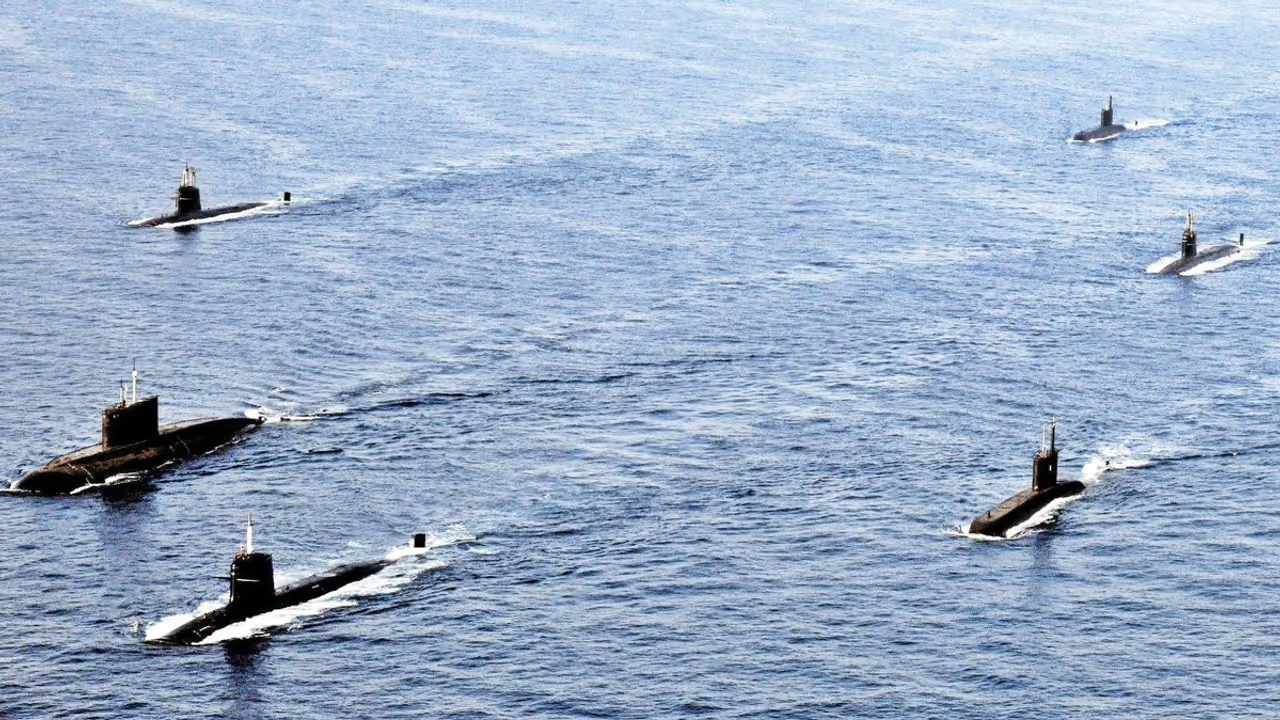
In a move aimed at significantly strengthening the Indian Navy’s long-range strike capability, the Ministry of Defence has issued a Request for Information (RFI) for the procurement of Land Attack Cruise Missiles (LACMs) for conventional submarines.
New Delhi: In a move aimed at significantly strengthening the Indian Navy’s long-range strike capability, the Ministry of Defence has issued a Request for Information (RFI) for the procurement of Land Attack Cruise Missiles (LACMs) for conventional submarines.

Designed to engage land-based targets with precision, the proposed LACMs will provide the Navy with enhanced long-range strike capabilities and a high probability of kill, further reinforcing its technological edge in missile warfare.
The RFI does not specify the number of missiles planned for procurement. However, it requires vendors to disclose whether the same or similar missile systems are currently being supplied to other customers.
Related Articles

Under the offset clause, vendors will be required to undertake offset obligations amounting to 30 percent of the total value of the commercial contract.
According to the specifications outlined in the RFI, the missile must weigh less than 1,500 kg (including capsule) and have a strike range between 50 km and 500 km. It must be capable of launch from a 533-mm submarine weapon tube using guide rails, with the missile length not exceeding 6.4 metres.
The system must support launch from periscope depth, between 15 metres and 100 metres, with the submarine travelling at speeds of up to 6 knots under normal operating conditions and up to 8 knots during emergency ejection.
“The platform must be capable of firing a salvo of two missiles without mutual interference between their homing heads,” the RFI states.
Additionally, the missile must withstand submarine roll and pitch of up to 45 degrees over 8–10 seconds. Targeting should be based on geographical coordinates, and the system must remain operational in dense electronic warfare environments.
The LACM must be equipped with an insensitive high-explosive warhead, either as a single unit or with sub-munitions, and be optimised for air-burst and pre-fragmented effects. Warhead reliability is required to be no less than 0.99.
The manufacturer must also provide an upgrade pathway valid for a minimum of 25 years as part of the contract.