
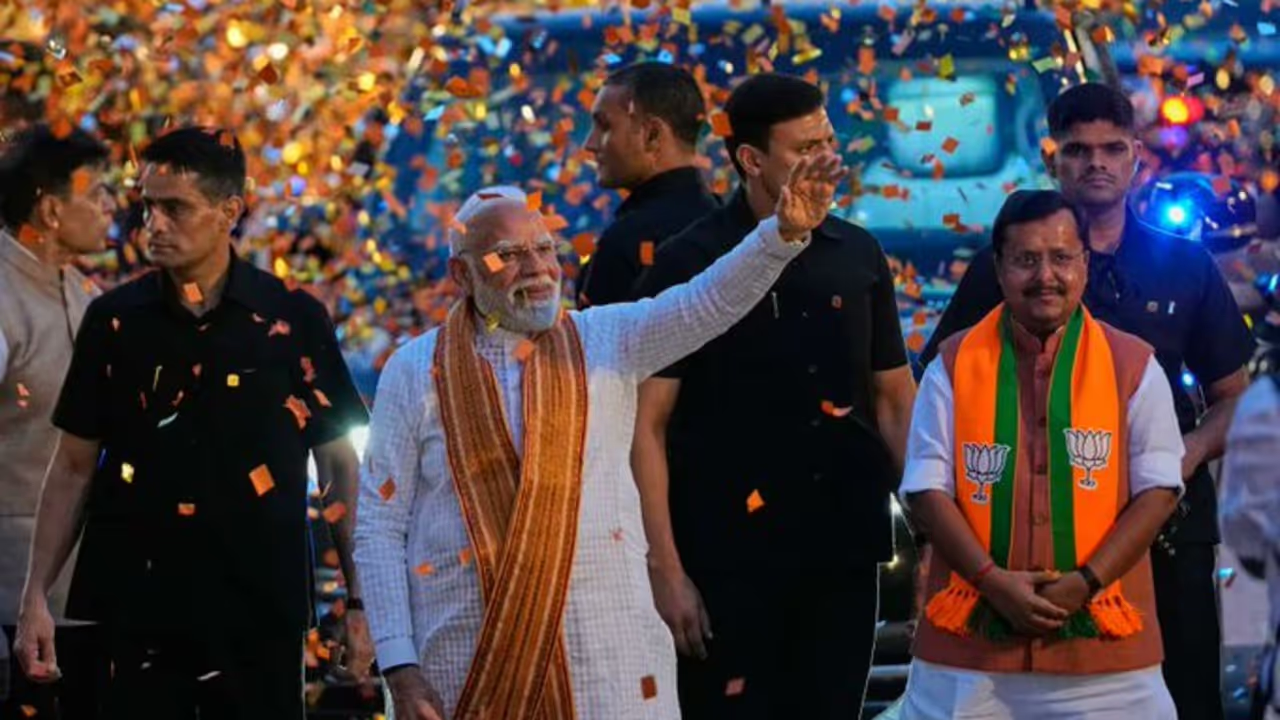
Following 2026 Assembly elections, the BJP-led NDA expanded its rule to 21 states, a significant consolidation of power. A historic victory in West Bengal, ending 15-year incumbent government, was pivotal to this expansion. This dominance, driven by strong leadership and strategic campaigning, is comparable to the Congress era under Indira Gandhi.
The 2026 round of Assembly elections has marked a defining moment in India’s political trajectory, with the Bharatiya Janata Party (BJP)-led National Democratic Alliance (NDA) expanding its footprint to govern 21 states across the country. This consolidation of power, driven by a historic victory in West Bengal and strong performances in Assam and other regions, signals a major shift reminiscent of the Congress dominance during Indira Gandhi’s peak years.

At the heart of this transformation lies the BJP’s breakthrough in West Bengal, a state that had long resisted the party’s expansion. Ending Mamata Banerjee’s 15-year rule, the BJP secured a decisive majority, marking its first-ever government in the state. The victory is not just symbolic but strategic, establishing the party firmly in eastern India and reshaping the national political balance.
Prime Minister Narendra Modi hailed the victory as a milestone, saying, “I bow to each and every person of West Bengal.” His statement reflected both gratitude and the broader significance of the mandate, which he framed as a triumph of governance and development-focused politics.
From Regional Limits to Nationwide Reach
With this latest expansion, the BJP-led NDA now governs a majority of India’s states, covering nearly 70–80% of the country’s population and geographical area. This level of dominance has not been seen in decades, drawing comparisons to the era when the Congress party, under Indira Gandhi, wielded unmatched influence across India.
The BJP’s growth has been both steady and strategic. From being a party largely confined to northern and western India, it has successfully expanded into the northeast, central India, and now the east. Victories in Assam, retention of power in key states, and gains in new territories reflect a broader national acceptance of its political narrative.
The addition of West Bengal is particularly significant. For years, the state had been a stronghold of Left parties and later the Trinamool Congress (TMC). By breaching this bastion, the BJP has demonstrated its ability to penetrate regions with distinct political and cultural identities.
The Modi Factor and Centralised Campaigning
A major driver behind the BJP’s continued success is the leadership of Prime Minister Narendra Modi. His personal popularity, combined with a highly centralised campaign strategy, has allowed the party to maintain a consistent message across states.
Modi’s rallies and messaging emphasised governance, development, and national security, themes that resonated with voters across diverse regions. His leadership style has also helped unify the party’s efforts, ensuring that local campaigns align with national priorities.
Union Home Minister Amit Shah also played a critical role, particularly in states like West Bengal, where the BJP lacked a strong local leadership base. The Modi-Shah combination has proven effective in converting organisational strength and campaign intensity into electoral success.
Also Read: BJP's Suvendu Adhikari secures major win over Mamata in Bhabanipur
Anti-Incumbency and Opposition Fragmentation
Another key factor behind the BJP’s expanding dominance is the presence of strong anti-incumbency sentiments against regional parties. In West Bengal, voters expressed dissatisfaction with governance issues, corruption allegations, and law-and-order concerns under the TMC government.
At the same time, the opposition at the national level remains fragmented. Despite attempts to form a united front, differences among opposition parties have limited their ability to present a cohesive challenge to the BJP. This fragmentation has allowed the BJP to consolidate votes and expand its influence across states.
The 2026 election results further underline this trend. While the Congress managed a comeback in Kerala, it struggled to make significant gains elsewhere. Regional parties, too, faced setbacks, with their traditional strongholds increasingly under pressure.
Ideology, Welfare and Development
The BJP’s electoral success is rooted in a combination of ideological appeal and governance promises. The party has effectively blended its core ideological positions with welfare schemes and development initiatives, creating a broad-based appeal.
Its campaign narratives often highlight infrastructure development, economic growth, and social welfare programs, alongside issues such as national security and identity. This dual approach has helped the BJP connect with a wide spectrum of voters, from urban middle classes to rural populations.
In states like West Bengal, the BJP also focused on local issues such as alleged corruption and administrative inefficiencies, positioning itself as a credible alternative to the incumbent government.
Controversies and Opposition Pushback
Despite its successes, the BJP’s rise has not been without controversy. Opposition leaders have raised concerns about electoral processes and governance practices.
Mamata Banerjee, reacting to the West Bengal results, alleged irregularities, calling the outcome “immoral” and “illegal,” and claiming that several seats were “looted.” These allegations highlight the heightened political tensions following the election and signal that the contest for political dominance is far from over.
There have also been criticisms regarding voter roll revisions and their potential impact on electoral outcomes. While the government and Election Commission have denied any wrongdoing, such concerns continue to fuel political debates.
A Shift Comparable to the Congress Era
The scale of the BJP-led NDA’s dominance has drawn inevitable comparisons to the Congress party’s peak under Indira Gandhi. During that era, Congress governed most states, shaping national policies with minimal opposition resistance.
Today, the BJP finds itself in a similar position, with control over a majority of states and significant influence over national discourse. However, there are key differences. Unlike the Congress system of the past, the current political landscape is more competitive, with regional parties still holding ground in several states.
Moreover, India’s electorate has become more dynamic and unpredictable, as evidenced by the emergence of new political forces in states like Tamil Nadu.
Also Read: BJP-NDA storms to power in Assam with a thunderous three-fourths win
Implications for National Politics
The BJP’s expanded footprint is expected to have far-reaching implications for national governance and policy-making. With control over more states, the party is better positioned to implement its agenda, including potential reforms such as the Uniform Civil Code and synchronized elections.
The results also strengthen the BJP’s position ahead of future national elections, providing momentum and reinforcing its image as the dominant political force in India. Analysts suggest that this could further challenge opposition efforts to build a unified alternative.
At the same time, the results underscore the importance of state-level politics in shaping national outcomes. The BJP’s ability to adapt its strategies to local contexts while maintaining a consistent national narrative has been a key factor in its success.
Conclusion: A New Political Order
The 2026 Assembly election results mark a turning point in India’s political evolution. With the BJP-led NDA now governing 21 states, the country is witnessing a consolidation of political power not seen in decades.
The party’s expansion into new regions, combined with strong leadership and strategic campaigning, has redefined the contours of Indian politics. Yet, challenges remain—from opposition resistance to governance expectations in newly won states.
As India moves forward, the BJP’s dominance will continue to shape policy, politics, and public discourse. Whether this phase marks the beginning of a long-term political realignment or a peak before future challenges will depend on how the party navigates governance and opposition in the years ahead.
