
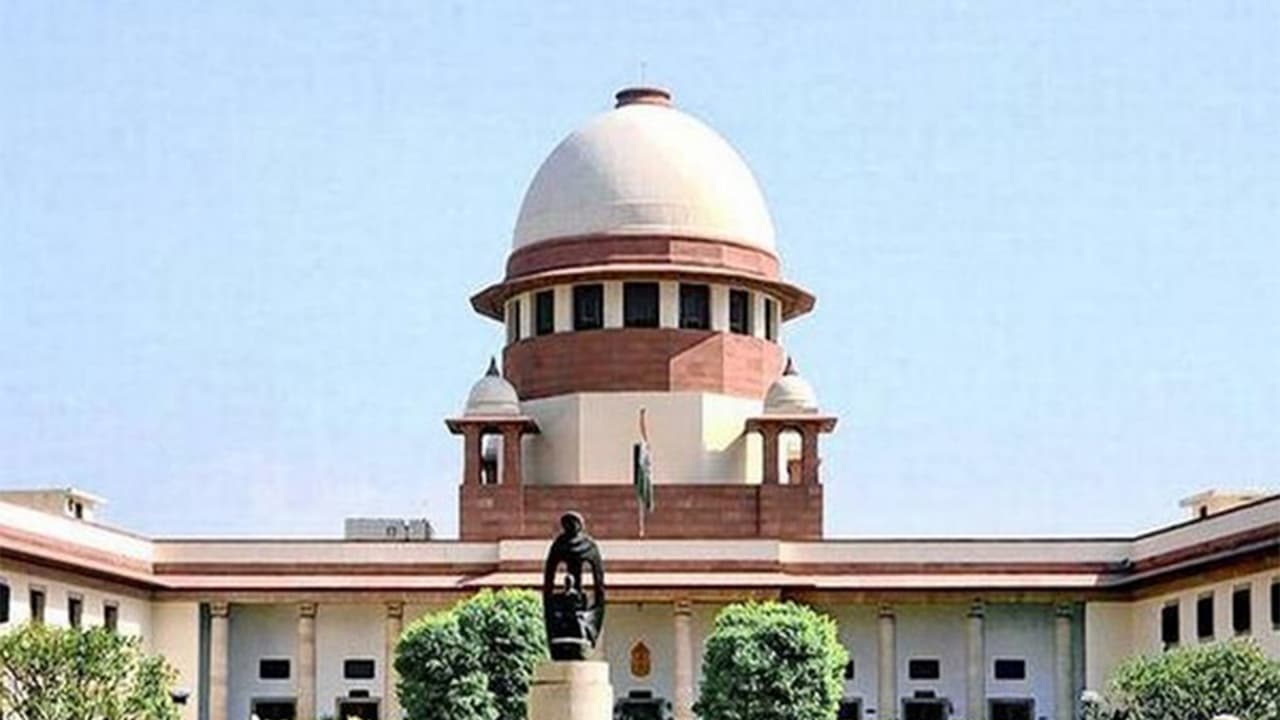
The Supreme Court has asked the MP High Court to consider objections to the ASI's videography of the disputed Bhojshala-Kamal Maula Mosque site. The High Court will address these objections during the final hearing on the matter.
Supreme Court's Directive on ASI Videography
The Supreme Court has asked the Madhya Pradesh High Court to consider objections raised by either parties over the videography conducted by the Archaeological Survey of India (ASI) of the disputed Bhojshala-Kamal Maula Mosque site, located in the central state's Dhar district.

For Hindus, the Bhojshala complex is a temple dedicated to Goddess Vagdevi (Saraswati) built in 11th century, while for Muslims, it is the site of the Kamal Maula mosque built during the regime of Mehmood Khilji (II) in 1514.
High Court Proceedings and Next Steps
A bench led by the Chief Justice of India (CJI) Surya Kant noted that all objections raised by the parties over the videography concerning the disputed religious site would be decided by the High Court during the final hearing. "We have no reason to doubt that the High Court will, after seeing the videography, consider objections of either parties as per principles of natural justice. We have not expressed any opinion on merits. Everything is open to be taken up at the High Court," the apex court noted.
Earlier on March 16, Indore Bench of MP High Court held a hearing in relation to the disputed Bhojshala-Kamal Maula Complex issue and directed if any party is yet to file its objection or suggestion related to the report of the Archaeological Survey of India (ASI), then it may submit before the next hearing, which is scheduled for April 2. "Parties may submit their respective objections/opinion/suggestions or recommendations in respect of the report of the Archaeological Survey of India before the next date, if not already filed, in terms of the directions contained in para 9(ii) and (iii) of the order dated 22.01.2026. The Court proposes to visit the site before the next date of hearing," the order read.
Advocate Seeks Additional Time
Meanwhile, Bhoj Utsav Samiti Advocate Shreesh Dubey said they sought additional time from the court to file their suggestion, which the court granted and instructed to file it before the next hearing. "During the previous hearing, the court gave three weeks time to the parties to submit their suggestions or objections. Most of the suggestions and objections from the parties have now been received. Though, we had sought additional time from the court to submit our suggestions, which the court accepted and directed that to be submitted before the next hearing. The next date of hearing in the matter has been scheduled for April 2," Dubey said.
ASI Survey Findings
On the directions of the Indore Bench of the Madhya Pradesh High Court, the ASI has conducted a scientific survey of the Bhojshala Temple-Kamal Maula Mosque complex to clarify its original nature. The ASI had conducted a 98-day scientific survey of the disputed complex before submitting its report on July 15, 2024. The detailed report stated that "based on scientific investigations, surveys and archaeological excavations conducted, study and analysis of retrieved finds, study of architectural remains, sculptures, and inscriptions, art and sculptures, it can be said that the existing structure was made from the parts of earlier temples."
Government records note that the remains of the original Saraswati temple can still be seen within the Kamal Maulana Mosque complex. The mosque's vast open courtyard, pillared corridors, and the prayer hall to the west incorporate ornately carved columns and ceilings that originally belonged to Bhojshala temple.
Historical Background of the Complex
Prakrit hymns describing Kurmavatara, the crocodile incarnation of Vishnu, and serpent-bound pillar inscriptions containing the Sanskrit alphabet, grammatical rules, tenses, and moods have been recovered from the site. The complex was originally a temple of goddess Sarasvati built by Parmar dynasty King Bhoja in 11th Century AD. For over 270 years, Bhojshala flourished as a centre of scholarship.
In 1305 AD, Alauddin Khilji defeated the Parmars, bringing their rule to an end. Bhojshala, along with many religious and historical sites, suffered destruction. Later in 1514 AD, Mahmud Shah Khilji II attempted to convert Bhojshala into a mosque. A tomb was built outside, associated with Kamal Maulana despite historical records showing that Maulana had died over two centuries earlier, in 1310 AD. (ANI)
(Except for the headline, this story has not been edited by Asianet Newsable English staff and is published from a syndicated feed.)