
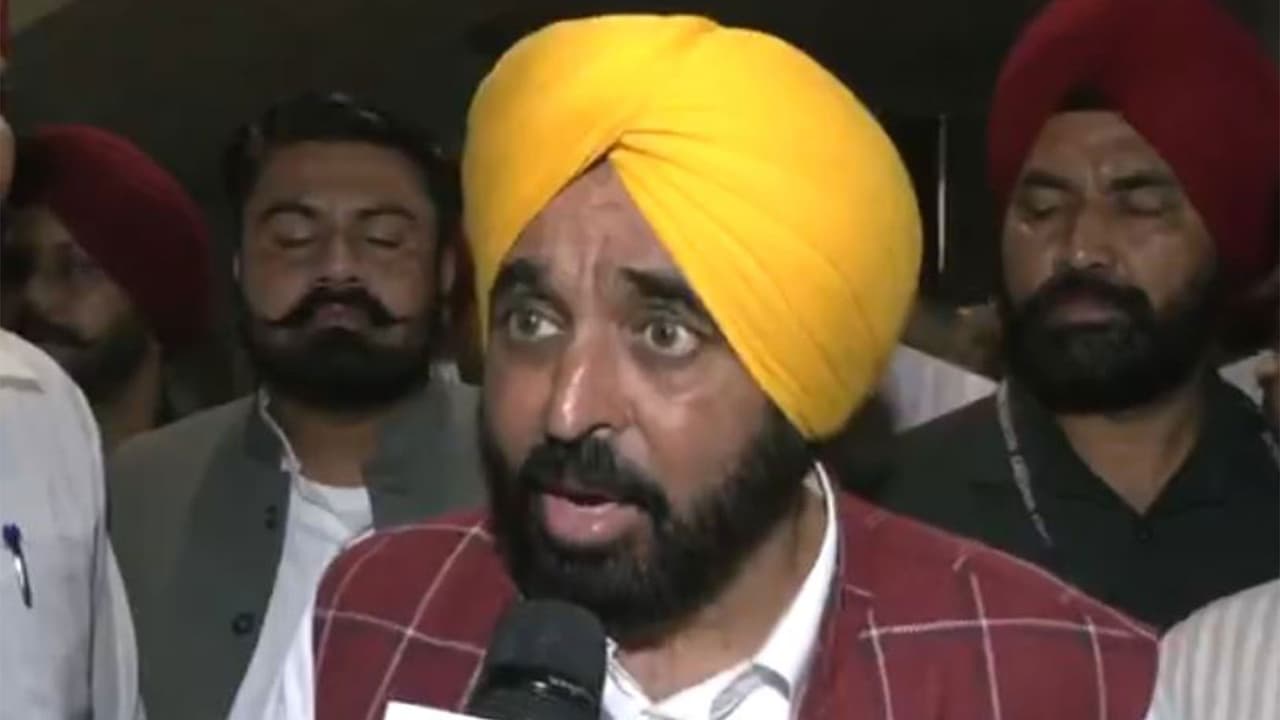
Punjab CM Bhagwant Mann criticised the India-US trade deal in the state assembly, alleging it will harm agriculture. He said importing US soy meal would create unfair competition due to farm size disparity and hurt crop diversification efforts.
Punjab Chief Minister Bhagwant Mann on Tuesday criticised the Centre over the proposed India-US trade arrangement, alleging that the agreement could severely affect agriculture in Punjab and put farmers in the state at a disadvantage.

Speaking to ANI after addressing a session in the Punjab Assembly, the Chief Minister claimed that the proposed deal could allow the import of American agricultural products such as soy meal for animal and poultry feed, which he said would make it difficult for local farmers to compete with large-scale farming in the United States.
Impact on Punjab's Agriculture
"Today in the Punjab Assembly, we discussed the Indo-US treaty - a secret agreement that is being finalised - which will have a dangerous impact on Punjab's agriculture. Under this deal, 'Soya Meal' will be imported from the US to be used as animal and poultry feed," Mann said.
Highlighting differences in farm sizes between the two countries, he questioned how Indian farmers would compete with American agricultural production. "In America, the average farm size is 500 acres, while in Punjab it is a mere 2.5 acres. How can our farmers compete with their industrial-scale production?" he said.
Threat to Crop Diversification
Mann also raised concerns about the potential impact of the trade arrangement on crop diversification efforts in the state. "We are trying to move toward crop diversification, but this treaty will kill our efforts. Our maize, cotton and Narma will be the worst hit," he said.
Unfair Competition in Textile Sector Alleged
The Chief Minister further alleged that the arrangement could create an uneven trade structure in the textile sector. "The arrangement is such that India will import their cotton, manufacture garments, and sell them back to America without tariffs. However, if garments are made from our own local cotton, they will impose tariffs. How is this fair? How can we survive this competition?" he asked.
Political Attack on Centre
Launching a broader political attack on the Centre, Mann said the country was promised global leadership but was instead becoming dependent on other nations. "We were promised that India would become a 'Vishwa Guru,' but instead we have become a 'Vishwa Shishya' or even a 'Vishwa Chela.' Modi ji is selling out the country," he alleged, referring to Prime Minister Narendra Modi.
Drawing a historical comparison, CM Mann said the situation reminded him of colonial history. "We remember how the East India Company arrived - they came under the guise of trade and ended up ruling us for 200 years. This feels like history repeating itself," he said.
Resolution Against 'Grave Injustice'
The Punjab Chief Minister also criticised the Centre over rising prices and the government's response to global conflicts. "The government is now talking about price hikes due to the ongoing war. They should have anticipated this earlier," he said, adding that the government should have stockpiled essential commodities.
"This is a grave injustice. We have passed a resolution in the Punjab Assembly condemning this treaty. Punjab is an agrarian state, and as its Chief Minister, it is my duty to protect our farmers. I will raise my voice against this at every possible platform," CM Mann added.
Details of the India-US Interim Trade Agreement
The India-US Interim Trade Agreement focuses on reducing tariff barriers while balancing India's domestic agricultural sensitivities with the US's demand for market access.
The US has agreed to reduce reciprocal tariffs on Indian goods from as high as 50% to 18%. This benefits Indian exports in textiles, leather, footwear, and pharmaceuticals.
India has expressed an "intent" (non-binding) to purchase $500 billion worth of US energy (LNG/Crude), aircraft (Boeing), technology, and coking coal over the next five years.
The US will grant duty-free access to Indian agricultural products such as spices, tea, coffee, mangoes, grapes, and cashews, potentially boosting Indian agri-exports, which reached $4.45 billion in 2024-25.
The US has agreed to lift the 25% penal duty previously imposed on Indian goods (linked to India's Russian oil purchases), provided India maintains its commitment to the new trade balance. (ANI)
(Except for the headline, this story has not been edited by Asianet Newsable English staff and is published from a syndicated feed.)