
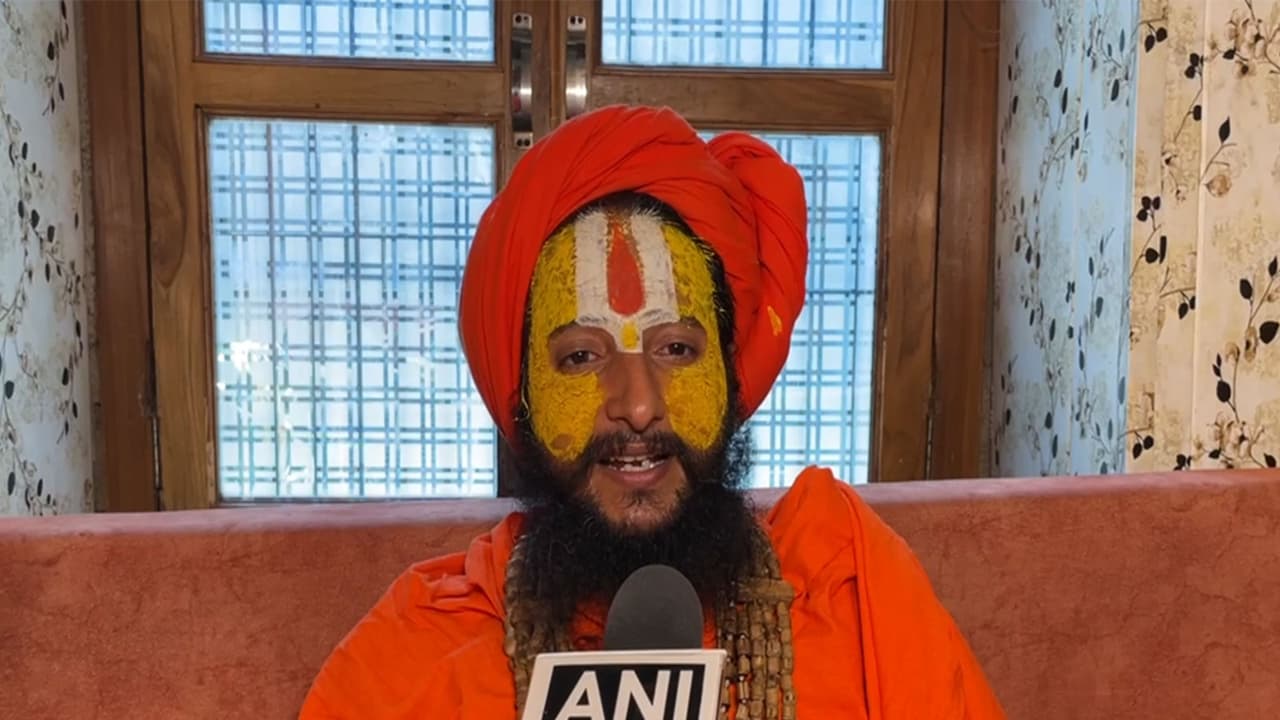
Ayodhya seers voiced support for PM Modi's 'Developed Bengal' vision ahead of the second phase of polling. They urged voters to liberate the state from TMC's 'misrule' and highlighted Bengal's rich cultural and revolutionary history.
Seers from Ayodhya on Tuesday voiced their support for the vision of a "Developed Bengal" following Prime Minister Narendra Modi's special message to voters ahead of the second phase of polling. Saint Varun Das Ji Maharaj remarked, "The atmosphere is charged with intense activity, and this time, the Bengal election has captured the attention and the gaze of the entire nation."

Speaking to ANI, Sitaram Das Ji Maharaj, the presiding head of Saket Bhawan, stated that, "Now that campaigning for the second phase in West Bengal has concluded, the sole intent of the masses participating in this second-phase election is to liberate themselves from the misrule and anarchy of the TMC."
Bengal's Cultural Significance
Speaking on the matter, the revolutionary saint Varun Das Ji Maharaj remarked that the atmosphere is charged with intense activity, and this time, the Bengal election has captured the attention--and the gaze--of the entire nation. "Bengal is the land of Mother Chandi; it is the land of Mother Durga. Moreover, Bengal is a land steeped in culture. Wherever you look across the entire country--even in places where only a handful of Bengalis reside--a distinct Bengali culture is invariably present. It manifests through the presence of a temple dedicated to the Mother Goddess, a unique cultural ethos, and specific culinary traditions; the confluence of all these elements creates a discernible cultural identity," he said.
A Cradle of Revolution
Speaking on the historical weight of the region, Varun Das Ji Maharaj emphasised, "Bengal has historically provided leadership to the nation and has served as a cradle of revolution. It was from this very land that Swami Vivekananda set forth to hoist the banner of Sanatan Dharma high upon the global stage, and from here, too, that Subhash Chandra Bose emerged to lead the Indian forces in the struggle to liberate the country."
"Therefore, in this election, Bengal is capturing everyone's attention. The voters will undoubtedly cast their votes peacefully, and the results will be seen on May 4th," he added.
The Vision of a United 'Sonar Bangla'
Exploring the historical context of the region, he said, "To create a truly 'developed Bengal,' one would, in fact, require the inclusion of Bangladesh as well; only if the Indian government possesses the capacity to bring Bangladesh into the fold can a truly developed Bengal be realised. If one desires the Bengal of the pre-1950 era--the "Sonar Bangla" (Golden Bengal) of yore--it cannot be achieved until both Bangladesh and West Bengal are united. This is precisely why the region is referred to as "West Bengal"; the territory now known as Bangladesh (formerly East Pakistan) constitutes the eastern portion of the historical Bengal. "
"Although there is currently only one Bengal situated within India, it continues to be designated as "West Bengal" solely to keep this historical reality alive in the collective consciousness. Deep within the heart of every Bengali, there lingers a persistent ache--a sense of grievance that a land which once hosted such magnificent monasteries and produced such towering figures--great souls like Anukul Thakur, Bankim Chandra, and many others--should have met such a fate. From any rational perspective, East Bengal ought never to have been ceded to Pakistan, given the vast cultural and geographical chasm that separated them, " he added.
The polling for the second phase of the West Bengal Assembly elections will take place on April 29, with counting of votes on May 4. (ANI)
(Except for the headline, this story has not been edited by Asianet Newsable English staff and is published from a syndicated feed.)