
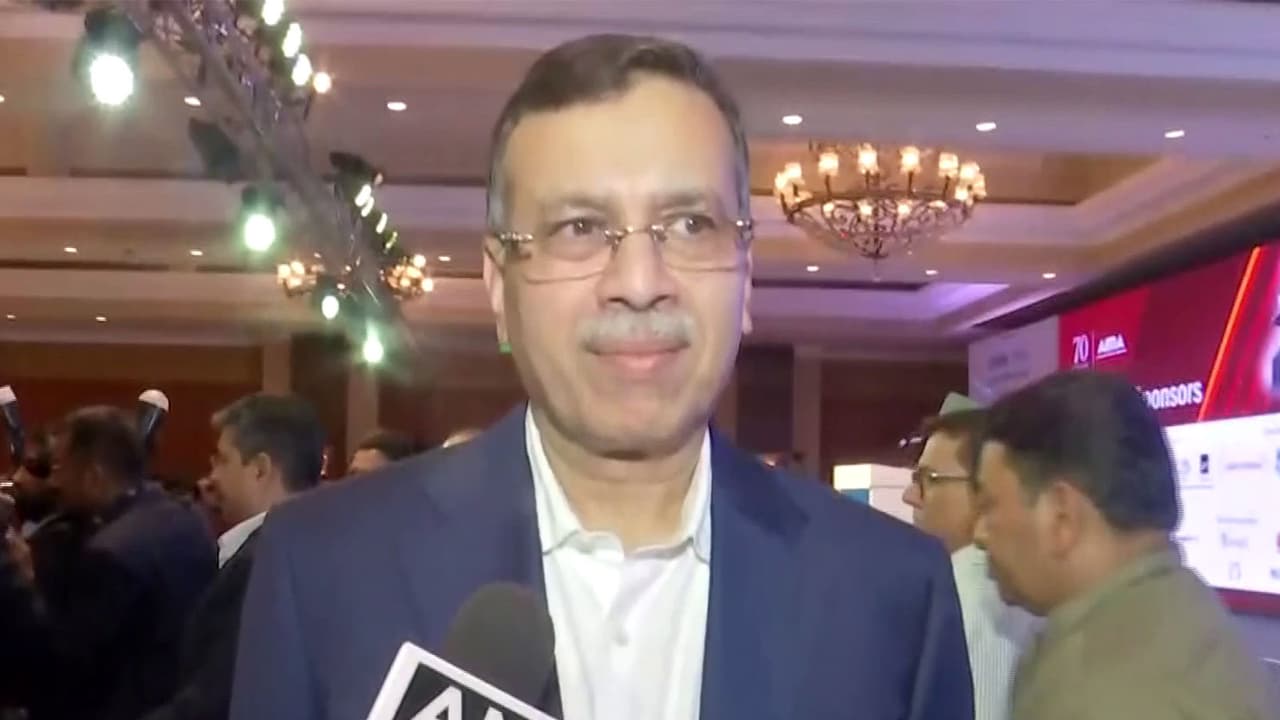
At the AIMA event, Sanjiv Goenka lauded young leaders like Karan Adani and Ananya Birla. Adani reflected on the Hindenburg report, stressed the critical need for AI adoption, and outlined the Adani Group's focus on infrastructure and governance.
India's top business leaders gathered at the 70th Foundation Day and 20th National Management Day of All India Management Association (AIMA) in Delhi to recognise excellence in management. RP-Sanjiv Goenka Group Chairperson Sanjiv Goenka praised young achievers like Karan Adani, Ananya Birla, and Mohit Suri for achieving in 10-15 years what used to take 40 years. Speaking to ANI, Goenka highlighted a shift in the Indian corporate landscape. By recognising figures like Karan Adani and Ananya Birla, Goenka pointed out that the barrier to entry for "excellence" has lowered in terms of age, but risen in terms of required impact. "It is a great event. It is about recognising excellence... Very young people got awards here because they achieved things in 10-15 years that used to take 40 years to achieve. You've got Karan Adani, Ananya Birla, Mohit Suri, you have Rapido, they are examples for everyone to emulate," he said.

Ananya Birla expressed gratitude for the Young Business Leader Award, dedicating it to her team. "The Young Business Leader Award by AIMA means so much for me... This is for my team... This means a lot."
Karan Adani on Hindenburg Learnings and India's Narrative
Meanwhile, in a candid reflection on the Hindenburg Research report, Karan Adani, Managing Director of Adani Ports & Special Economic Zone Ltd (APSEZ), identified the dual challenges of financial structure and global perception, highlighting his company's strong infrastructure and lessons learned from financial structuring challenges. He emphasised the importance of sharing India's narrative globally. "The positive is our businesses are with hardcore infrastructure... The weak point of ours at that point in time was our financial structuring at the family level, at the group level. It was a big learning experience for us when we went through that. That is something we realised is a big danger we were carrying. We corrected ourselves quickly. The second danger that we see is that we don't tell our story quite often. We don't put our narrative out in the world... Given India's situation, we have to give our narrative to the world, give our context to the world, and that's something that we lack as a country also," said Karan Adani.
Adani on AI Adoption: 'Adapt or Perish'
On AI adoption, Karan Adani stated that organisations not embracing AI will struggle to survive. AI will enhance efficiency, not replace humans, and enable faster scaling. He stressed the need for retraining employees to mitigate job losses and social pressure. Adani issued a stark warning: any organisation that does not adopt AI will not survive the next decade. "Any organization which does not adopt AI, honestly, 10 years down the line, will not survive... AI is not going to replace human beings, but it's just going to make us more efficient... It will allow us to scale up much faster... It is the responsibility of any organisation to retrain its people. Because without that, it is going to create a lot of social pressure. It means you are going to have job losses... The second thing that will hamper is new job creation... But that's also an opportunity in terms of how we bring in more industries? The faster we scale manufacturing, the better it is forthe country."
Adani Group's Strategic Focus on Infrastructure and Governance
The Adani Group is strengthening its focus on national infrastructure priorities, defence-linked ecosystems and internal governance as it navigates rapid expansion, Karan Adani said on Saturday. Speaking at an interaction hosted as part of the All India Management Association's (AIMA) platinum jubilee celebrations, Karan Adani, Managing Director (MD) of Adani Ports and Special Economic Zone (APSEZ) and Director at Adani Cement, outlined the conglomerate's evolving capital allocation strategy.
Three Pillars of Investment
Karan Adani, the eldest son of Adani Group Chairman Gautam Adani, said investments remain centred on three pillars: energy, logistics and core materials critical to India's development. Energy infrastructure, including city gas distribution, power transmission networks and emerging digital assets such as data centres, will remain a long-term focus.
Strengthening Defence Ecosystem
On defence participation, he said indigenisation is a strategic national objective. He pointed to maintenance, repair and overhaul (MRO) capabilities, including a recent partnership with Brazil's Embraer, as part of a broader aviation and defence ecosystem integrating domestic manufacturing with global supply chains.
Addressing Organisational Challenges
Addressing organisational challenges, Karan Adani acknowledged that rapid expansion had increased management layers, slowing decision-making. Restoring speed and scalability while reducing structural complexity is now a priority, he said, according to a release. The Group is working to lower its average employee age, currently 38, to accelerate artificial intelligence (AI) adoption. He noted that the Group's broader USD 100 billion investment commitment announced this week, aimed at building renewable energy-powered infrastructure by 2035, also underpins its long-term AI and digital ambitions.
Workforce Development and Diversity
Female workforce participation has risen to 15 per cent from 2 per cent earlier. Around 80 per cent of leadership has been developed internally, with mobility encouraged across ports, airports, cement and mining operations.
Enhancing Governance and Credibility
Responding to audience questions on governance and credibility following regulatory scrutiny and media coverage, Karan Adani said resilience depends on strong operating fundamentals and transparent communication. He described the Group's core infrastructure portfolio as a structural strength due to recurring revenues but acknowledged earlier concentration risks. Institutionalisation and broader partnerships are part of strengthening governance frameworks, he said. (ANI)
(Except for the headline, this story has not been edited by Asianet Newsable English staff and is published from a syndicated feed.)