
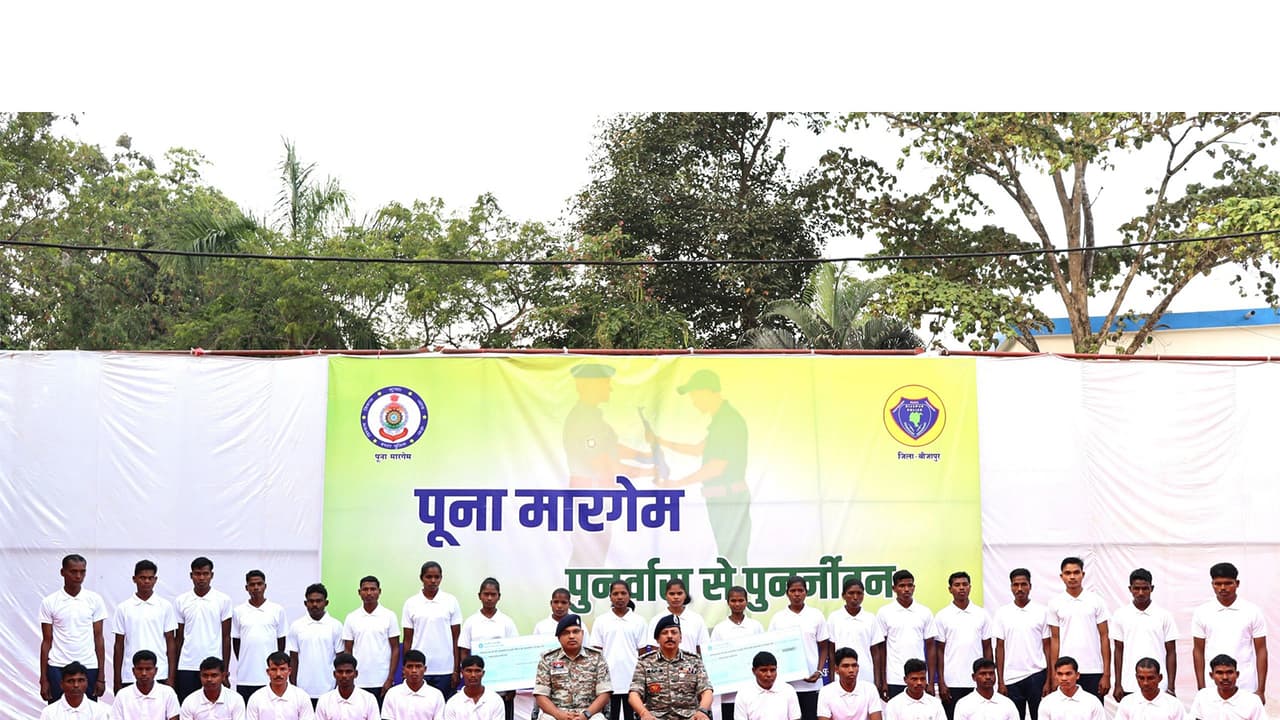
34 Naxals, including seven women, surrendered in Chhattisgarh's Bijapur district. The Maoist cadres carried a collective reward of Rs 84 lakh and surrendered under the state's 'Poona Margham' rehabilitation initiative for lasting peace.
As many as 34 Naxals surrendered in Chhattisgarh's Bijapur district, marking a significant breakthrough in the state's ongoing efforts to curb Left-Wing Extremism and restore lasting peace in the region.

Details on Naxal Surrender
The surrendered Maoist cadres were collectively carrying a reward of Rs 84 lakh, the Bijapur Police said.
The surrender took place under the state government's rehabilitation initiative titled "Poona Margham: Punarvas Se Punarjeevan" (Return to the Mainstream: Social Reintegration through Rehabilitation), which focuses on reintegrating former extremists and welfare-based measures.
Officials said the move reflects the growing impact of sustained anti-Naxal policies combined with confidence-building efforts.
Among those who laid down arms were 34 Maoist belonging to the South Sub-Zonal Bureau, including seven women and 27 men.
In addition to the DKSZC unit, the surrendered Naxals included members from the Telangana State committee and the Andhra-Odisha Border (AOB) division, indicating that the schemes extend beyond district and state boundaries.
Intensified Anti-Naxal Operations
Bijapur district has witnessed notable progress in recent months. Since January 1, 2024, a total of 824 Maoists have surrendered, while 1,079 have been arrested. During the same period, 220 Maoists were killed in separate encounters, underlining the intensified counter-insurgency operations.
Government's Comprehensive Policy
Officials credited the success to the state government's comprehensive Naxal eradication policy, which balances firm security action with rehabilitation, employment assistance and social reintegration.
They reiterated that former cadres willing to abandon violence would continue to be welcomed into the mainstream, as authorities push for long-term peace and stability in the region.
Development Dawns in Sukma with New CRPF Camp
Meanwhile, a ray of hope has dawned over Peddabodkel village in Sukma district as the newly inaugurated CRPF camp brings security and development to an area once dominated by Naxalite influence.
Villagers, who previously had to travel long distances to access basic services, are now witnessing tangible benefits from healthcare, infrastructure and government welfare schemes.
Nestled amid dense forests and hilly terrain, Peddabodkel was long considered a Naxal stronghold, with authorities finding it nearly impossible to establish a government presence.
With the inauguration of the CRPF camp on December 10, the government's flag now flies in the area for the first time since independence.
Residents are now availing essential services, including medical care, road connectivity, electricity, and clean water, reflecting a broader push towards integrating the village into the mainstream.
Sukma Range CRPF DIG Anand Singh Rajpurohit said, "You will see that the Peddabodkel camp, which has been opened, is to secure the route from Narsapuram to Raigudem. With the opening of the camp, development will accelerate in the surrounding villages. Electricity, roads, and water - all these facilities will be available. The work of the district administration will also progress. We will provide Aadhaar cards and all other facilities inside the camp." (ANI)
(Except for the headline, this story has not been edited by Asianet Newsable English staff and is published from a syndicated feed.)