Solar System: Diamond Rain to Floating Planets, 10 Mind-Blowing Facts!
Our solar system is way more bizarre and dynamic than what our school textbooks taught us. From Venus being super hot to diamond rain on Neptune, and the Sun holding almost all the mass—here are some unbelievable secrets.
111
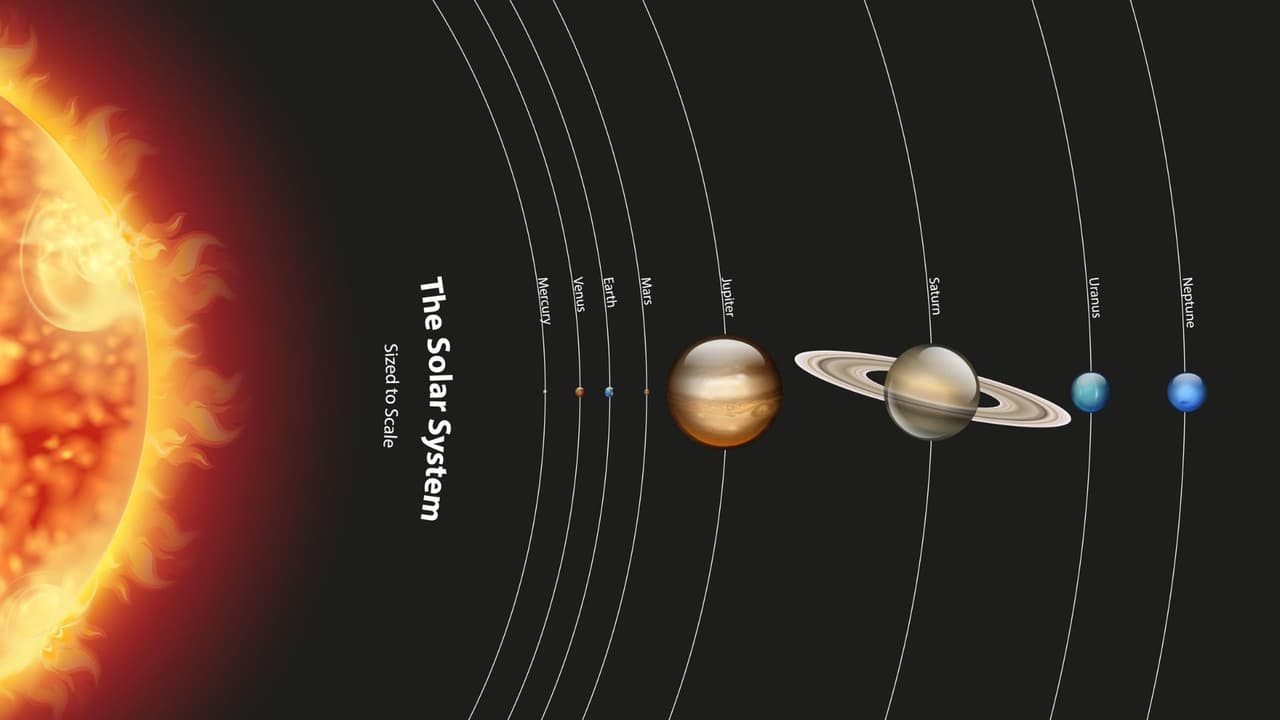
Image Credit : nasa
Incredible Secrets of the Solar System
The solar system is a wild place, full of incredible physics and geological quirks. What we learn in school about the order of planets is very different from what actually happens out there. For instance, Venus is hotter than Mercury, and its surface is a volcanic hellscape. Scientists believe it 'rains diamonds' in the atmospheres of Neptune and Uranus, the 'ice giants'. According to NASA's solar system exploration records, the Sun alone contains 99.8% of the total mass of the solar system. These 10 facts show just how dynamic our universe is, way beyond any textbook.
Add Asianet Newsable as a Preferred Source
211

Image Credit : nasa
Mercury, the Iron Planet
NASA's MESSENGER mission found that Mercury's metallic core makes up about 85% of its radius. For comparison, Earth's core is only about 50% of its radius. Scientists guess that a massive collision during the solar system's early days might have stripped away Mercury's outer rocky layers.
311
Image Credit : nasa
Pluto and the Oort Cloud
While Pluto is a dwarf planet, the 'Oort Cloud' is a theoretical 'bubble' of icy debris that marks the outer boundary of the Sun's gravitational pull. It's about 1.6 light-years away and is the birthplace of most long-period comets. Think of the Oort Cloud as a giant spherical shell surrounding our solar system, acting as the outer edge of the Sun's influence.
411
Image Credit : nasa
The Sun Holds 99.8% of the Solar System's Mass
It's impossible to grasp the scale of our universe from Earth. According to NASA, the Sun alone holds 99.86% of our solar system's total mass. This means all the planets, moons, asteroids, and comets combined make up less than 0.2%. If the entire solar system were the size of a regular front door, Earth would be just the size of a small coin.
511
Image Credit : nasa
Saturn, the Planet That Can Float on Water
Saturn is a gas giant with such low density that it could actually float on water. It's made up mainly of hydrogen and helium. According to NASA science, it's the only planet in the solar system with a density lower than water. If you could find a bathtub big enough to hold Saturn, it would definitely float.
611
Image Credit : nasa
Why Is Venus the Hottest Planet?
Even though Mercury is closer to the Sun, Venus has a much higher surface temperature. The European Space Agency (ESA) explains that Venus suffers from a 'runaway greenhouse effect'. Its carbon dioxide-rich atmosphere traps heat intensely. This keeps Venus's surface at a constant 470 degrees Celsius—hot enough to melt lead.
711
Image Credit : nasa
The Distance Between Planets is About 8,000 Kilometres
Space is almost entirely empty. The Jet Propulsion Laboratory (JPL) points out that even if you lined up all the planets in the solar system side-by-side, there would still be about 8,000 kilometres of space left between the Earth and the Moon. This shows just how far apart the planets are compared to the vast vacuum of space.
811
Image Credit : nasa
Diamond Rain on the Ice Giant Planets
Deep inside Neptune and Uranus, the weather is truly spectacular. Research from the SLAC National Accelerator Laboratory shows that the extreme pressure deep inside these planets separates carbon from methane. This carbon then transforms into diamonds, which fall like rain towards the core.
911
Image Credit : nasa
Jupiter's 'Great Red Spot'
Jupiter's most famous feature is a massive storm that has been raging for hundreds of years. But it's slowly disappearing. In the 1800s, the Great Red Spot was 40,000 kilometres wide (big enough to fit 3 Earths inside). Current data shows the storm has shrunk to 16,500 kilometres and is getting smaller every year.
1011
Image Credit : nasa
Olympus Mons VS Mount Everest
Mars has some of the most impressive geology in the solar system. The volcano 'Olympus Mons' on Mars is 21.9 kilometres high. That's nearly three times taller than Mount Everest, the highest mountain on Earth. Since Mars lacks plate tectonic activity, this volcano has been growing over a single 'hotspot' for billions of years, allowing it to reach its massive size.
1111
Image Credit : nasa
The Kuiper Belt
The solar system extends far beyond Neptune into a cold region full of frozen objects, sometimes called a 'junkyard'. According to NASA's New Horizons mission, the Kuiper Belt contains millions of icy bodies. Scientists have identified at least three dwarf planets here—Pluto, Haumea, and Makemake. The Kuiper Belt provides a 'fossil record' of how the early solar system developed.