
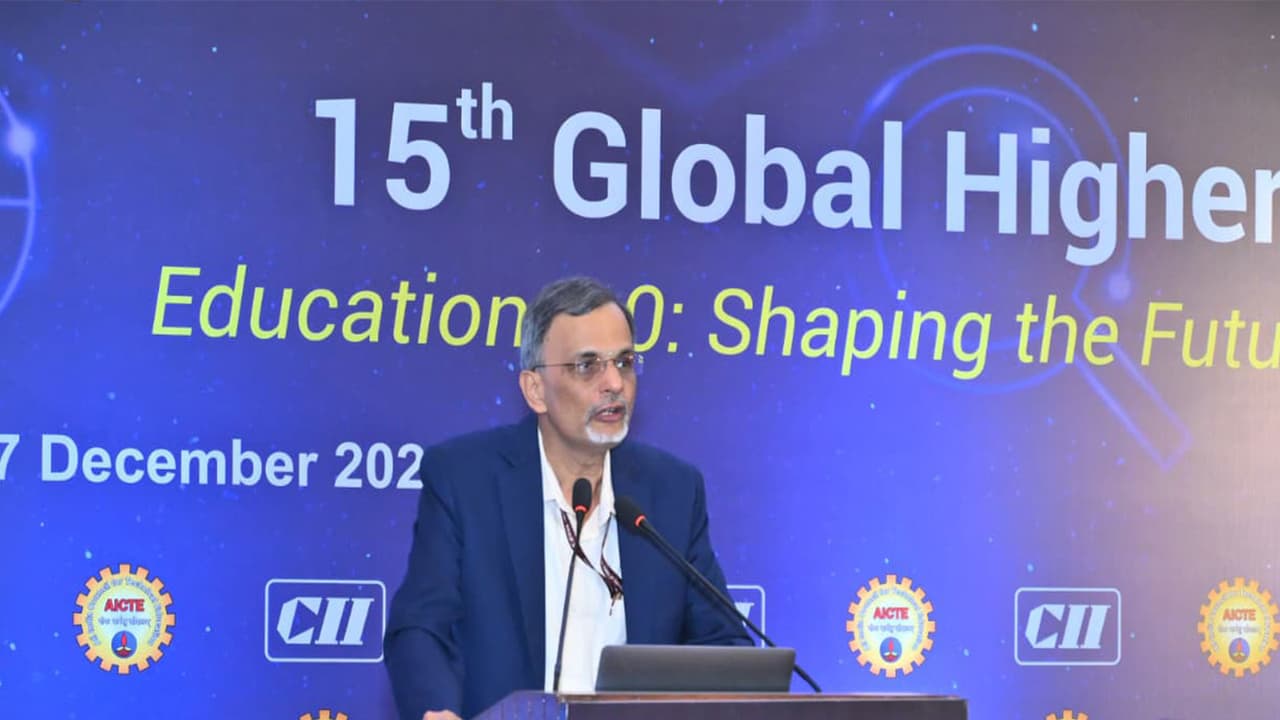
CEA Anantha Nageswaran states that states are pivotal for India's next higher education reform phase. He calls for a shift from control to stewardship, addressing faculty shortages, and deeper industry engagement to leverage India's unique position.
States' Role and Industry Collaboration
States hold the key to the next phase of higher education reform in India, said Anantha Nageswaran, Chief Economic Adviser to the Government of India, during the CII Global Higher Education Summit on Wednesday here in the national capital. He outlined key priorities for states, including a shift from control to stewardship, the urgent addressing of faculty shortages through mechanisms such as professors of practice, moving from input-based to outcome-based regulation, adopting an entrepreneurial approach in public administration, and financing institutions based on differentiated roles and outcomes. Nageswaran also called for deeper industry engagement in curriculum design, research, and governance. "Industry can co-design curricula, offer credit-bearing internships, support applied research, share infrastructure, and participate meaningfully in governance," he said, adding that collaboration between government, states, industry, and citizens can help India move from scale to leadership and emerge as a global hub for learning, research and ideas.

A Unique Moment for Ambitious Reform
The CEA noted that the present moment is uniquely suited for ambitious reform due to four converging factors; India is at a demographic and economic inflection point, with millions of young people entering the working-age population over the next two decades, making the quality, relevance and adaptability of higher education central to converting the demographic dividend into sustained growth; the global higher education landscape is undergoing a structural shift, as traditional destination countries face demographic, fiscal and political constraints, while Asia emerges as a new centre of gravity for learning, research and innovation, creating an opportunity for India to become a destination for global learners; technology has broken long-standing constraints through digital platforms, hybrid delivery models, modular credentials and AI-enabled pedagogy, enabling quality education to scale in ways not possible earlier; and the policy groundwork has already been laid through the National Education Policy (NEP) 2020 and evolving regulatory thinking, making this a moment for focused execution and institutional courage rather than disruption without preparation.
Creating a Future-Ready Ecosystem
Prof Anil Sahasrabudhe, Chairman, National Education Technology Forum, highlighted how recent reforms in higher education are creating a future-ready, student-centric ecosystem anchored in quality, flexibility and innovation. He noted that the proposed new regulatory framework will bring all higher education regulators under a single umbrella with a single-window approval system, enabling institutions to offer multidisciplinary programs with greater ease. Emphasising the transformative impact of the National Education Policy 2020, he highlighted the National Credit Framework and digital enablers such as APAR ID, which together empower students with flexible, multidisciplinary learning pathways and verifiable, paperless academic credentials.
Balancing Technology and Human Values
Prof Sahasrabudhe stressed that while emerging technologies such as artificial intelligence, augmented and virtual reality, simulations and digital platforms are powerful enablers, human intelligence, ethics and values will always remain central. Addressing the future of work, he observed that amid uncertain projections on job disruption, resilience, lifelong learning, research and innovation will be critical, calling for deeper collaboration between government, industry, and academia.
Human Capital as the Core of Resilience
Naushad Forbes, Past President, CII and Chairman, CII National Higher Education, R&D, Technology and Innovation Council and Co-Chairman, Forbes Marshall, highlighted that the deepest source of long-term resilience for any economy or institution lies in the quality of its human capital, which is built through a combination of education and accumulated skills. He said that economic transformation depends not only on the creation of knowledge but on the ability of skilled individuals to translate ideas into practical outcomes. Emphasising the central role of higher education in innovation, he called for a substantial increase in public research funding within universities. He argued that universities must primarily be seen as creators of talent and advocated a shift from prescriptive regulation towards greater autonomy and competition.
Aligning Education with the Future of Work
Nandini Rangaswamy, Co-Chairperson, CII National Higher Education Council and Chairperson, GRG Institutions, said the future of work is being reshaped by rapid technological advances, particularly in AI, robotics, and digital systems, alongside geopolitical and economic disruptions, making it imperative for education systems to lead change rather than react to it. She noted that while India's higher education enrolment has expanded significantly, scale without quality and relevance cannot deliver national transformation. Emphasising the Education 5.0 framework envisioned under NEP 2020, Rangaswamy called for a shift towards competency-based, multidisciplinary and lifelong learning, with research, innovation, and industry collaboration at the core. "If we align policy, institutions, industry, and talent with clarity and conviction, India can not only prepare for the future of work but shape it," she added. (ANI)
(Except for the headline, this story has not been edited by Asianet Newsable English staff and is published from a syndicated feed.)