
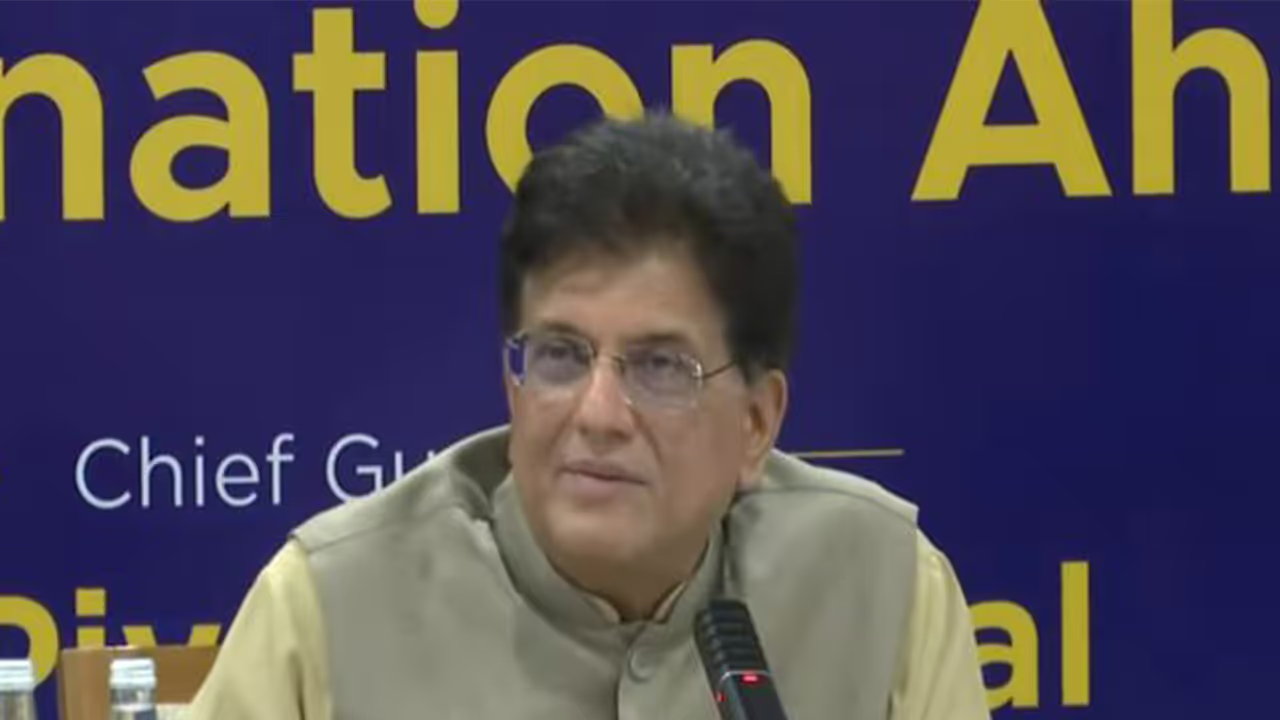
Piyush Goyal credits PM Modi's 2014 decisions, including the creation of a unified National Grid and expanded solar targets, for laying the groundwork for India's ambitious growth and a potential trillion-dollar tech industry by 2035.
India's Ambitious Growth Rooted in 2014 Decisions
Union Minister of Commerce and Industry Piyush Goyal on Thursday reflected on India's economic and energy transformation over the past decade, crediting key decisions taken in 2014 under Prime Minister Narendra Modi for laying the groundwork for the country's ambitious growth trajectory. Speaking at the Launch of NITI Frontier Tech Hub's Roadmap on India's Technology Services, Piyush Goyal noted that, during Prime Minister Atal Bihari Vajpayee's tenure, the government made a conscious decision to stay out of the industry's way, allowing businesses to flourish independently. He described this non-interventionist approach as one of India's key success stories.

"Moving to 2014, when Prime Minister Narendra Modi assumed office, several foundational decisions were taken that often go unrecognised when discussing the sector's growth and future potential," he said.
Responding to projections of a USD 700-800 billion industry, he playfully urged citizens to think bigger toward a trillion-dollar opportunity by 2035. He emphasised that a pivotal set of decisions made in 2014 laid the groundwork for achieving such ambitious goals.
From 'Baptism by Outage' to a Unified National Grid
Goyal recalled that on May 26, 2014, the day the new government was sworn in, Delhi was in darkness following a massive power outage caused by voltage fluctuations that collapsed the northern grid. Tasked with overseeing the Power, Renewable Energy, and Coal Ministries, he described his early tenure as a "Baptism by Outage."
"The crisis became a catalyst for the creation of a unified National Grid. Today, India has the world's second-largest grid, possibly after China. Unlike Europe's smaller country-wise grids or America's regional grids, similar to India's pre-2014 structure that contributed to the blackout, India moved toward a fully integrated national system," he said.
"This transformation coincided with another major 2014 decision, dramatically expanding India's solar energy ambitions. At the time, India had approximately 1.4-1.5 gigawatts of solar capacity, and the previous target had been 20 gigawatts by 2022. Prime Minister Modi raised the target to 100 gigawatts by 2022, providing significant impetus for renewable energy. To integrate this intermittent solar and wind power effectively, a strong National Grid was essential," he said.
Delivering Collateral Benefits and Strengthening Infrastructure
"The reforms delivered multiple collateral benefits. For instance, in 2012, South India faced acute power shortages, purchasing electricity at rates as high as Rs 12-14 per kilowatt-hour, while Northern India had surplus power going unused. At times, coal-based plants supplied power at extremely low or even negligible prices simply to maintain operational stability and support peak demand while accommodating renewable inputs," the minister highlighted.
He said that to support the transformation, the government added lakhs of circuit kilometres of transmission lines, expanded high-voltage direct current (HVDC) systems, and strengthened infrastructure in underserved regions, particularly the Northeast. These efforts created a robust energy backbone to support India's expanding industrial and technological ambitions.
A Future Led by Technology and Innovation
Looking ahead, Goyal expressed strong confidence in India's technological future. "The future holds immense promise for India. Let's go and capture global markets and become the hub of technology. Let artificial intelligence become the next frontier that India will adopt and lead," he said.
"India will lead the world with its trust, talent, and technological progress. India has resolved to move away from being just a software provider to the world and emerge as a nation that drives innovation, creates technology, and shapes the future," the minister said.
(ANI)
(Except for the headline, this story has not been edited by Asianet Newsable English staff and is published from a syndicated feed.)