
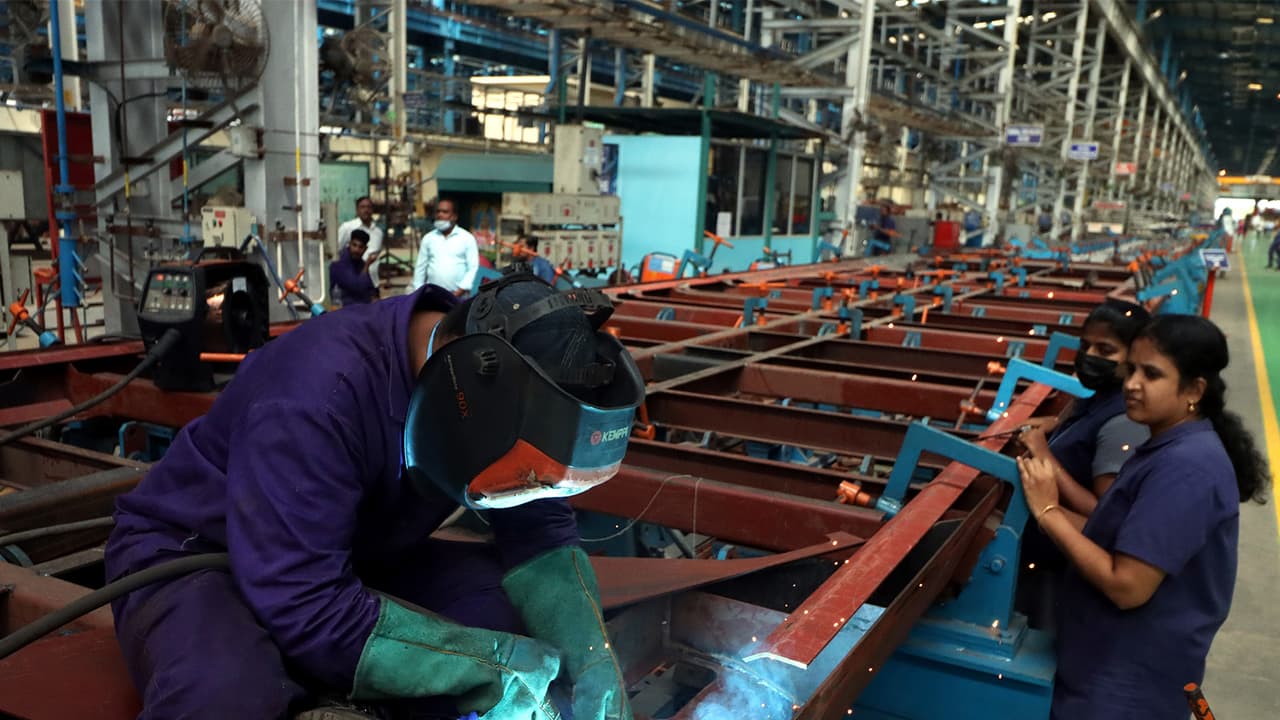
NITI Aayog's Neeraj Huddar warns India faces a $5.1T gap in its 2047 manufacturing goals, urging a shift to advanced tech. MSDE's Debashree Mukherjee calls the next 5 years critical for smart manufacturing, highlighting skilling schemes.
India needs to rapidly scale up advanced manufacturing and frontier technologies to meet its long-term growth ambitions, Neeraj Huddar, Resident Fellow at NITI Aayog and Lead Architect of the NITI Frontier Tech Hub, said on Monday, warning that a business-as-usual approach could leave a multi-trillion-dollar gap in economic output.

Speaking at the CII Smart Manufacturing Summit in New Delhi, Huddar said, "The vision of Viksit Bharat targets manufacturing contributing 25% of GDP by 2047, but under current trajectories India would fall short by about $5.1 trillion." "Bridging this gap will require transformative interventions anchored in advanced manufacturing, with focused action across key clusters such as engineering, consumer products, life sciences, electronics and chemicals, where frontier technologies can drive higher value addition and productivity," he added.
Government's Critical 5-Year Window for Smart Manufacturing
At the same event, Debashree Mukherjee, Secretary at the Ministry of Skill Development and Entrepreneurship (MSDE), said the government views the next five years as critical for building smart manufacturing capabilities.
"The opportunity is now, the next five years are critical for India to lead the shift toward smart manufacturing," Mukherjee said, emphasising that India's competitiveness would depend on how effectively MSME clusters transition to digitally driven production models. She highlighted the PM SETU scheme, which entails an investment of 600 billion rupees (USD 7.2 billion) over five years to create an industry-led skilling ecosystem through upgraded industrial training institute clusters, centres of excellence, a hub-and-spoke model and an expanded apprenticeship network. Hyperlocal planning and AI-driven skill mapping, she said, would enable firms to access the right talent at the right time.
Industry 4.0 Transforming Factories
Industry leaders said new technologies are already reshaping factories across sectors. Dilip Sawhney, Chairman of the CII National Committee on Smart Manufacturing and Managing Director of Rockwell Automation India, said tools such as CAD/CAM, 3D printing, smart sensors, blockchain, generative AI and machine vision are transforming design, production, quality and safety across industries, from textiles to electronics.
Ravi Raghavan, Co-Chairman of CII's National Committee on Capital Goods and Engineering and Managing Director of Bharat Fritz Werner, said the shift toward Industry 4.0 is not limited to large enterprises. "Mid-sized firms can often see faster impact with small, scalable digital steps, but true transformation happens when technology works alongside skilled people," he said.
Overcoming R&D and Data Readiness Hurdles
However, challenges persist, particularly in innovation and data readiness. C.V. Raman, former Chief Technology Officer of Maruti Suzuki India, said India's R&D intensity among automotive suppliers trails global peers, even as the sector moves toward electrification, batteries, hydrogen and advanced electronics.
Tejpreet Singh Chopra, Chief Executive of Bharat Light & Power, said many manufacturers continue to struggle with building robust data foundations for AI adoption. "For MSMEs, return-on-investment concerns persist, so AI must deliver clear operational value, whether in predictive maintenance, quality, safety or energy efficiency," he said.
The summit brought together policymakers, technology providers and industry leaders to deliberate on positioning smart manufacturing as a strategic priority for India's growth and global competitiveness.
(Except for the headline, this story has not been edited by Asianet Newsable English staff and is published from a syndicated feed.)