
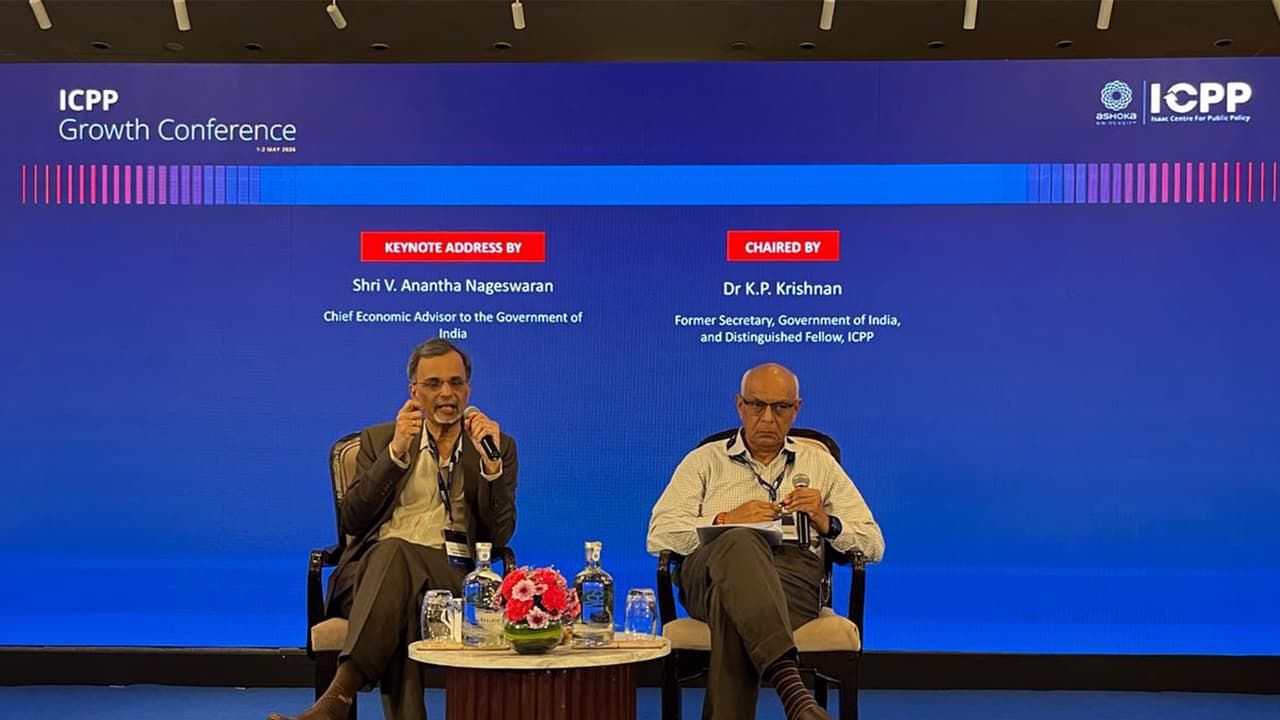
CEA V Anantha Nageswaran has warned that India's 4.3% fiscal deficit target may be hard to achieve due to surging global energy prices from the West Asia crisis, which he described as the country's 'most difficult' energy shock in memory.
India's fiscal deficit target of 4.3 per cent for the current financial year may be difficult to achieve, Chief Economic Advisor (CEA) V Anantha Nageswaran warned on Saturday, as surging global energy and fertiliser prices driven by the escalating West Asia crisis pile fresh pressure on the country's finances.

Speaking at the ICPP Growth Conference organised by Ashoka University, Nageswaran said India was facing its "most difficult" energy shock in recent memory, and called on policymakers to build strategic buffers to protect the economy from the widening fallout of the conflict.
Surging Global Prices and Economic Impact
Since the West Asia war broke out on February 28, crude oil prices have rocketed to above USD 120 per barrel, a four-year high, up sharply from around USD 73 before hostilities began. The surge has sent ripples across India's import bill, with rising petroleum and fertiliser costs threatening both the fiscal math and consumer prices.
Nageswaran warned that a below-normal monsoon combined with a pass-through of higher energy prices could trigger a "potential inflation spike" in the months ahead -- a double blow to households already feeling the pinch at the pump.
The CEA also flagged that India's current account deficit (CAD) could climb to over 2 per cent of GDP in the current fiscal year, a sharp deterioration from less than 1 per cent in FY26 -- underscoring the scale of the external pressure building on the economy.
Four-Pronged Shock from West Asia Crisis
Nageswaran identified four distinct channels through which the West Asia conflict is hitting India -- price and supply shock, trade disruption, sticky logistics costs, and a remittance shock -- cautioning that the crisis was not a passing storm.
"This conflict is going to be with us in some form or another... the military conflict may be over, but the strategic conflict is well and truly alive," he said. He noted that India imports 60 per cent of its LPG requirements, of which 90 per cent flows through the now-closed Strait of Hormuz, describing it as a "very challenging situation."
Government's Balancing Act
The government, he said, was already walking a tightrope -- partially passing through higher energy costs via commercial LPG pricing and export duties on diesel and ATF, while cutting excise duties on petrol and diesel to shield ordinary consumers. "We are arriving at a modus vivendi with respect to burden-sharing between fiscal policy, inflation, households and oil marketing companies. It has to be a balancing act," Nageswaran said.
India's Resilience and Future Strategy
Despite the headwinds, the CEA struck a note of measured confidence, saying India was better prepared than many peer economies to weather the crisis, owing to the fiscal space created by reducing the deficit ratio to 4.4 per cent of GDP in FY26.
He also called for building strategic reserves of critical minerals -- nickel, tin and copper -- saying import dependence in these areas was a vulnerability that needed urgent attention if India was to make a serious push in manufacturing.
Warning on AI and Employment
In a separate warning, Nageswaran said India faced a growing employment challenge from artificial intelligence, urging the IT sector to become more competitive and pivot towards creating AI-enabled jobs rather than losing existing ones to automation. (ANI)
(Except for the headline, this story has not been edited by Asianet Newsable English staff and is published from a syndicated feed.)