
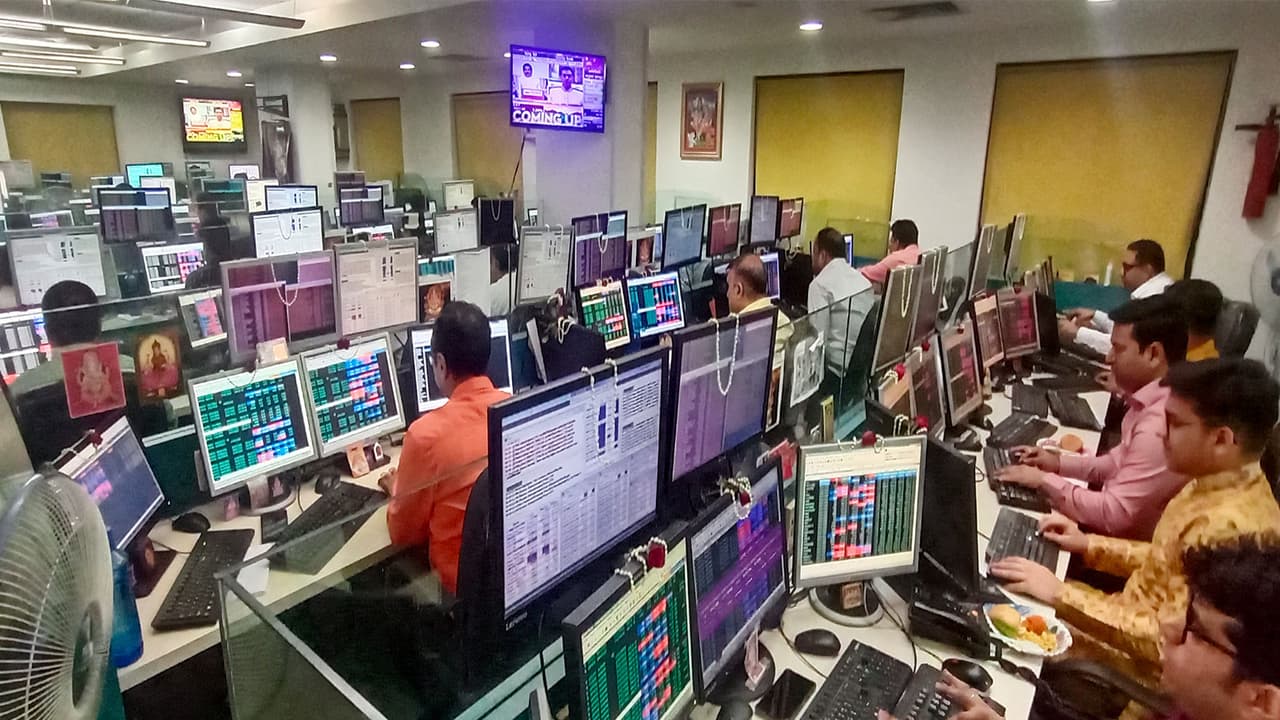
Indian benchmark indices Sensex and Nifty extended their bearish run, closing significantly lower on Wednesday. Sensex plunged over 1,000 points, driven by escalating geopolitical tensions in West Asia, which have pushed oil prices higher.
Indian stock indices extended their bearish run, with benchmark Sensex closed over 1,000 lower lower at the Wednesday closing bell, amidst escalating geopolitical tensions in West Asia that have invariably weighed down financial markets worldwide. Sensex closed 1.4 per cent down or 1,123 points down at 79,116 points. Similarly, Nifty closed at 1.6 per cent down or 385 points down at 24,480 points.

Market Fragility and Investor Advice
Vinod Nair, Head of Research, Geojit Investments Limited, said, "Global risk sentiment remained fragile amid ongoing tensions in the Middle East and the closure of the Strait of Hormuz, which kept oil prices volatile. Indian equities mirrored the broader risk-off environment due to the impact of inflation and potential for higher CAD. The continued depreciation of the INR also remains a key concern, while incremental foreign outflows lead to near-term volatility in the market. We advise investors to avoid panic sell-off and adopt a disciplined, long-term perspective and exercise patience over the next several weeks, as current price levels may offer a strategic entry point for the medium to long term."
Monday's Market Performance
Indian share markets were closed on Tuesday on account of Holi, with trading suspended on both the National Stock Exchange (NSE) and the BSE. On Monday, Indian stock indices settled in the red but recovered substantially from the early losses, amid escalating tensions in West Asia. Sensex closed at 80,238.85 points, down 1,048.34 points or 1.29 per cent, while Nifty closed at 24,865.70 points, down 312.95 points or 1.24 per cent.
According to SBI Securities, a sharp spike in crude oil prices amid escalating tensions in West Asia dampened investors' sentiment on Monday.
Expert Outlook on Market Risks
Asian markets are also trading negative today. Shrikant Chouhan, Head Equity Research, Kotak Securities, said, "Currently, the market is trading significantly below both short-term and medium-term averages, and on daily charts, it appears to be in a weak formation, indicating a largely negative outlook."
Three Key Risks for India
Ajay Bagga, a veteran financial market expert said Indian markets will look at three impacts from the Iran-US conflict. "The first risk transmitter is higher oil prices due to the de facto closure of the Straits of Hormuz. The second is the impact on major trading partners of India in the Gulf with Indian exporters suffering due to the closure of these shipping lanes and supply chains.The third is the risk to the 9 million Indians who work in the Middle East. What happens to their lives, livelihoods , remittances sent back home. These three will be the major questions and we are frankly not knowing enough to estimate the answers to these for now. The best outcome is that the new Iranian leadership chooses survival over ideology and returns to negotiations, allows tankers to sail down the Straits of Hormuz and stop attacking GCC targets," Bagga said. Bagga sees some buying on dips to start as extremely oversold markets start positioning for a sentiment reversal.
Global Pressure on Indian Economy
Financial markets turned sharply risk-off on Tuesday as mounting fears of an inflation surge rippled across stocks and bonds worldwide. "Global equities slid as disruptions to Middle East energy supplies threatened to reignite price pressures. Crude oil gained around 5 per cent, while European wholesale natural gas surged a punishing 40 per cent, said Devarsh Vakil, Head of Prime Research at HDFC Securities. Vakil said, "Prolonged tensions among the United States, Israel, and Iran are mounting pressure on India across its current account, inflation outlook, and currency stability. Elevated crude prices stand to raise the country's import bill, widen its current account deficit, weaken the rupee, stoke inflation, and trigger foreign capital outflows." (ANI)
(Except for the headline, this story has not been edited by Asianet Newsable English staff and is published from a syndicated feed.)