
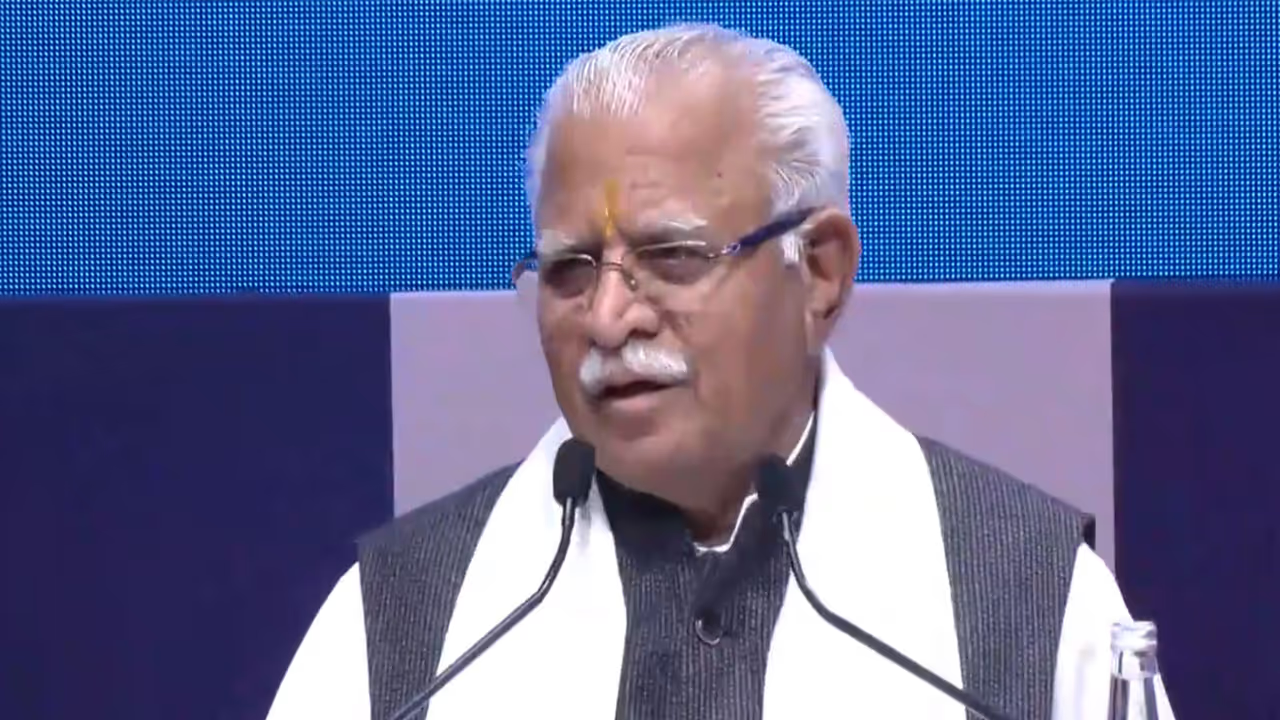
India is set to launch formal trading in its domestic carbon market within the next four months. Union Power Minister Manohar Lal said this will create an economic framework for climate action, allowing entities to trade carbon certificates.
India will begin formal trading in its domestic carbon market within the next four months, Union Power Minister Manohar Lal said on Saturday. The step will mark a key step in the country's efforts to curb emissions and create an economic framework for climate action.

"Within the next four months, formal trading in the carbon market will start in the country," the Union Minister said on the sidelines of the Bharat Electricity Summit 2026 held in the national capital. He added that stakeholders would be required to register under the scheme before participating in the trading of carbon certificates.
How the Carbon Market Will Function
The minister said the carbon market would function as a mechanism to balance emissions by allowing entities with surplus carbon credits to sell them to those falling short of compliance targets.
"Those who have carbon certificates will be able to sell them, while those who do not will buy them to meet their obligations," he said, describing the system as an incentive-driven approach to achieving carbon neutrality.
Broader Climate Action and National Goals
The Minister noted that India is intensifying efforts to reduce emissions through a mix of regulatory and market-based tools, as rising global temperatures underscore the urgency of climate action. He said global temperatures have already risen by about 1.4 degrees Celsius compared with the 1850-1900 baseline, with 2023 among the hottest years on record.
India is committed to achieving net zero emissions by 2070 under the Paris Agreement, and is scaling up renewable energy capacity while strengthening domestic policy frameworks. The minister reiterated that climate action is both a national and individual responsibility, requiring technology-driven solutions and behavioural change.
Compliance Framework and Existing Schemes
As part of its compliance framework, the government has set greenhouse gas emission intensity targets for 490 obligated entities starting in 2026. These entities will be required to reduce their carbon footprint, with the carbon market providing flexibility and economic incentives for compliance.
Success of the PAT Scheme
The Minister highlighted the success of the Perform, Achieve and Trade (PAT) scheme, under which 1,333 industries have been covered. The scheme has helped reduce carbon dioxide emissions by about 110 million tonnes, while also improving energy efficiency across sectors.
Complementary Energy Efficiency Measures
He also pointed to complementary measures such as smart metering, green open access and time-of-day tariffs, which are aimed at improving energy efficiency and promoting renewable energy adoption. India has set an ambitious target of installing 200 million smart meters, one of the largest such programmes globally.
A Long-Term National Asset
The minister said the carbon market would evolve into a long-term national asset, supporting entrepreneurship and innovation in clean technologies. "This is not just a market, but a national asset that will strengthen our economy and environmental responsibility," he said.
India's Role in Global Climate Discussions
India has also been actively engaging in global climate discussions, including at COP28 and the G20, where it supported calls to triple renewable energy capacity worldwide. The Union Minister said these efforts would help position India as a key player in the global energy transition while advancing its goal of becoming a developed nation. (ANI)
(Except for the headline, this story has not been edited by Asianet Newsable English staff and is published from a syndicated feed.)