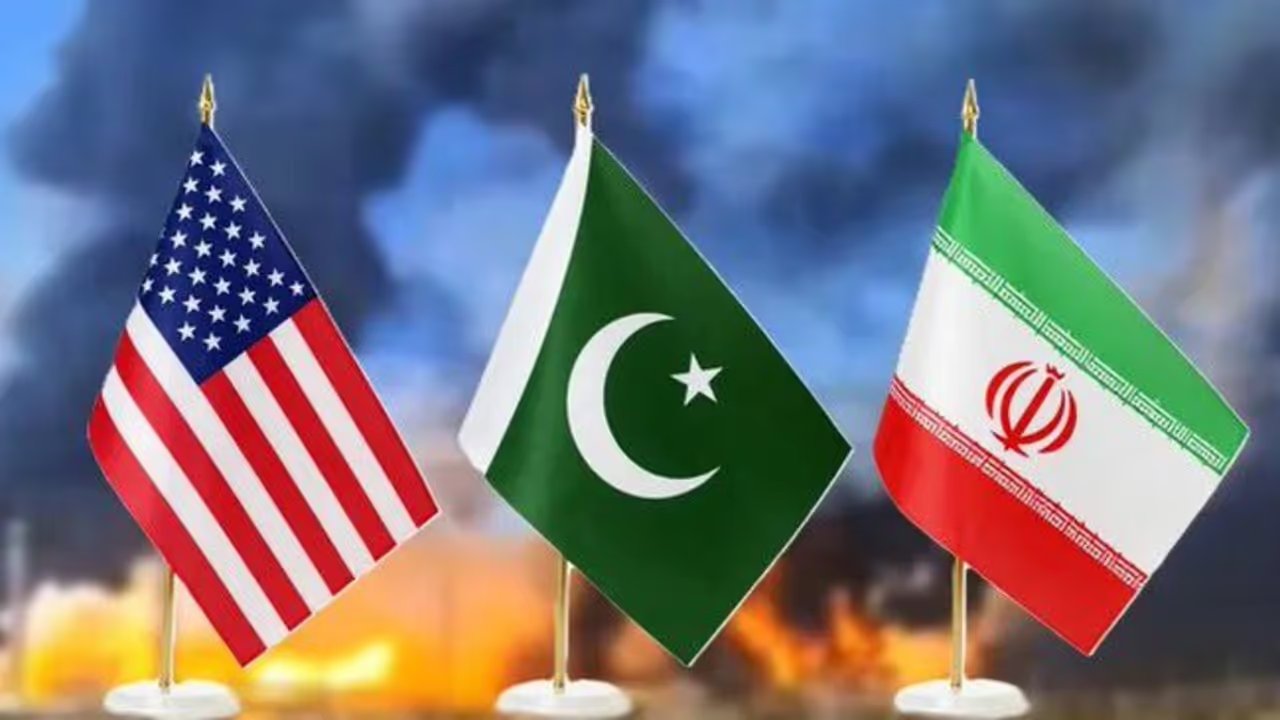
Global markets stayed cautious as hopes for a US-Iran ceasefire lifted sentiment, while uncertainty over upcoming Pakistan talks kept investors on edge. Oil prices held near $100 as the Strait of Hormuz remained partly disrupted. US inflation data came in lower than expected, supporting stocks.
Global stock markets showed a mixed trend on Friday, while oil prices remained steady. Investors stayed cautious but slightly hopeful that a ceasefire between the United States, Israel and Iran could hold. This fragile peace has been in place for around two weeks. However, uncertainty remains high as both sides have accused each other of not fully following the agreement.

Focus shifts to upcoming talks in ,Pakistan
All attention is now on talks expected to take place in Islamabad over the weekend. These discussions aim to turn the temporary ceasefire into a long-term agreement.
However, there is still confusion about the talks. There has been no clear update on when negotiators will arrive. This has added to the uncertainty in global markets.
Related Articles

Despite this, US Vice President JD Vance has left for Pakistan to lead the American team. He expressed cautious optimism, saying the talks could be positive if both sides act in good faith.
Oil prices remain steady but high
Oil prices stayed almost unchanged, just below the $100 per barrel mark. This is still much higher than before the recent conflict.
The Strait of Hormuz remains a key concern. This narrow route usually carries about one-fifth of the world’s oil supply. At present, only a small number of oil tankers are passing through it.
Any disruption in this area can quickly push oil prices higher, which is why investors are watching it closely.
Stock markets react differently across regions
Stock markets showed mixed signals across the world.
In the United States, trading started with little change. The Dow Jones fell slightly by 0.2 percent. The S&P 500 rose by 0.1 percent, while the Nasdaq gained 0.5 percent.
In Europe, markets performed better. London’s FTSE 100 rose by 0.2 percent, Paris’s CAC 40 increased by 0.5 percent, and Germany’s DAX climbed 0.7 percent.
Asian markets ended the day higher. Tokyo’s Nikkei 225 jumped 1.8 percent, while Hong Kong’s Hang Seng rose 0.6 percent and Shanghai’s Composite index gained 0.5 percent.
Earlier gains linked to ceasefire hopes
Markets had seen some recovery earlier in the week. This came after reports that Israel and Lebanon had agreed to hold talks, raising hopes that the wider conflict could calm down.
Even with this rebound, stocks are still lower and oil prices remain higher compared to levels before the conflict began.
Inflation data brings some relief
Investors were also watching inflation data from the United States.
Consumer prices rose by 3.3 percent in March compared to the previous year. This increase was mainly due to higher fuel costs. However, it was still lower than what many experts had expected.
Core inflation, which excludes food and energy prices, rose by 2.6 percent. This was also below forecasts, giving some relief to markets.
What inflation means for interest rates
Lower-than-expected inflation means the US Federal Reserve may not need to keep interest rates high for a long time.
If inflation had been higher, it could have delayed any rate cuts. Investors welcomed the data, which helped support stock markets.
However, experts warn that rising energy prices could push inflation higher again in the coming months.
Analysts urge caution despite positive signs
Market experts say investors are still being careful. David Morrison from Trade Nation said markets are “pausing to catch their breath” before the weekend.
Another analyst, Patrick J. O’Hare, said investors liked the inflation data but warned that oil price shocks could affect future inflation.
This shows that while there is some optimism, risks remain.
Details of key market movements
As of around 1340 GMT, Brent crude oil was slightly down by 0.2 percent at $95.69 per barrel. US West Texas Intermediate rose 0.2 percent to $98.10.
Currency markets also showed small movements. The euro rose to $1.1730, while the pound increased to $1.3475. The dollar strengthened slightly against the yen.
Vance leads high-stakes diplomatic effort
JD Vance’s visit to Pakistan is seen as a major step in US diplomacy. He is leading talks that could shape the future of the region.
He said the US is open to talks if Iran is willing to negotiate honestly. At the same time, he warned that the US would not accept any unfair deal.
The delegation includes key figures like Steve Witkoff and Jared Kushner, showing how important these talks are.
Rare moment in US-Iran relations
Direct talks between the US and Iran have been rare in recent history. One notable moment was in 2013 when US President Barack Obama spoke to Iran’s Hassan Rouhani.
This makes the current talks even more important. However, it is still unclear whether the discussions will be direct or indirect.
Tensions remain despite ceasefire
Even after the ceasefire, disagreements continue.
Iran says stopping Israeli action in Lebanon was part of the deal. But Israel’s Prime Minister Benjamin Netanyahu and former US President Donald Trump have rejected this claim.
At the same time, the US wants Iran to reopen the Strait of Hormuz. Trump has criticised Iran’s actions, saying it is not following the agreement properly.
A critical moment for diplomacy
Experts say this is a very important moment. JD Vance is playing a key role, even though he has limited experience in such high-level negotiations.
Some experts have pointed out that it is unusual for a US Vice President to lead peace talks linked to an ongoing conflict.
However, his approach may help create a new path for dialogue.
The outcome of these talks will affect not just the Middle East but the global economy. Oil prices, stock markets, and even inflation depend on stability in this region. Any progress in talks could bring relief, while failure could increase tensions.
For now, investors and governments around the world are watching closely, waiting to see what happens next.
(With AFP inputs)