
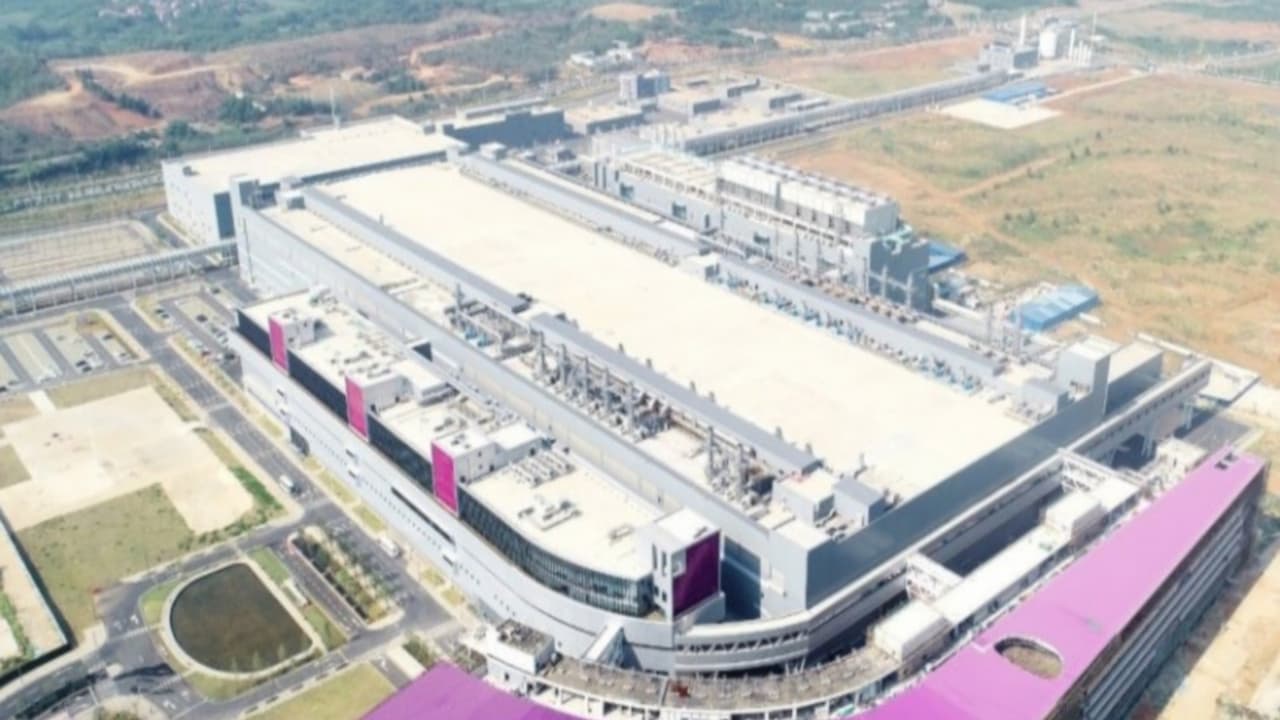
China's YMTC is accelerating its new NAND flash memory plant's mass production, set to challenge global leaders like SK hynix and Micron this year. The company is rapidly advancing its technology and increasing its global market share.
YMTC's Accelerated Growth and Market Challenge
China's Yangtze Memory Technologies Co. (YMTC) is rapidly closing the gap with global leaders in NAND flash memory, scaling up production and advancing technology faster than expected, according to a report by The Korea Herald.

Quoting the industry sources, The Korea Herald said YMTC has accelerated the timeline for its third-phase fabrication plant in Wuhan, bringing forward expected mass production from 2027 to as early as the second half of this year. The plant, which began construction in September 2025, is now in the final stages of equipment installation. With its first and second fabs already operating at full capacity, the additional output is expected to significantly boost YMTC's global presence. The company is seen as being on track to surpass SK hynix and Micron Technology in shipment volumes as early as this year, strengthening its position as the world's third-largest NAND supplier behind Samsung Electronics and Japan's Kioxia.
Expert Cites Lower Barriers in NAND Production
"NAND flash memory is less dependent on leading-edge lithography than DRAM or foundry processes," said Lee Jong-hwan, a professor in the department of system semiconductor engineering at Sangmyung University, noting it is a relatively more accessible area for Chinese firms to advance under US equipment sanctions, with greater reliance on domestically built tools. "The challenge from Chinese companies poses a credible competitive threat, underscoring the need for vigilance. Korean chipmakers should keep up with their R&D efforts to reinforce their technological edge." he added.
Rising Market Share and Production Volume
YMTC's share of global NAND shipments has already risen to around 13 per cent in the third quarter of last year from about 10 per cent in the first quarter, and is expected to reach 15 per cent this year. The company processed about 1.29 million wafers in 2024, increasing to 1.77 million last year, with output projected to approach 2 million this year. In comparison, Samsung is expected to process about 4.7 million wafers and Kioxia about 4.69 million wafers.
Technological Advancements and Strategic Focus
YMTC's growth has been driven by a volume-focused strategy and expansion into global markets. While its revenue share remains at around 11 per cent, the company is rapidly increasing its presence in consumer markets such as smartphones, PCs and automotive applications. The company has also made technological progress, achieving around 270-layer NAND and launching products with 294-layer chips. It is now preparing to mass-produce NAND exceeding 300 layers later this year. This narrows the gap with global leaders, as SK hynix currently produces 321-layer NAND and Samsung is at 286 layers.
Financial Strengthening and Future Plans
YMTC is also strengthening its capabilities through continued investment and its proprietary Xtacking 4.0 chip architecture, improving yield rates and production stability. The company has established a new entity with registered capital of 20.72 billion yuan (about USD 3 billion) and is considering a domestic listing, with its valuation expected to exceed USD 40 billion.
Korean Chipmakers' Response to Competition
Meanwhile, Korean chipmakers are responding by focusing on advanced and high-margin products. Samsung has halted 128-layer NAND production at its Xian plant and is ramping up 236-layer chips, with plans to introduce 286-layer NAND in 2026 and eventually move beyond 400 layers. SK hynix is also increasing investment, raising spending at its Dalian plant by more than 50 per cent last year to 440.6 billion won, while continuing to develop next-generation technologies such as high-bandwidth flash.
The intensifying competition highlights a shifting landscape in the global semiconductor industry, as Chinese firms gain ground and established players move up the technology chain to maintain their edge. (ANI)
(Except for the headline, this story has not been edited by Asianet Newsable English staff and is published from a syndicated feed.)